Streamlining enterprise processes with AI, using ServiceNow
A look under the hood at how ServiceNow is transforming procurement and admin tasks.
Published 2024-12-19
.jpg)
Do you want to dig into how AI is shaping the future of business operations?
In a recent live workshop, Ben George, a Solutions Consultant at ServiceNow, showed us how AI can make office work easier and faster.
ServiceNow started as a company helping IT departments handle support tickets. Now, they use AI to make work simpler, save money, and help different teams work better together.
Buying and managing supplies for businesses is Ben’s bread and butter. In the workshop, he showed us how AI can help big companies, especially with buying and managing supplies. If you work in purchasing, office management, or just want to learn how AI can improve everyday work tasks, this workshop is a must-watch.
Here’s a peek at what Ben covered.
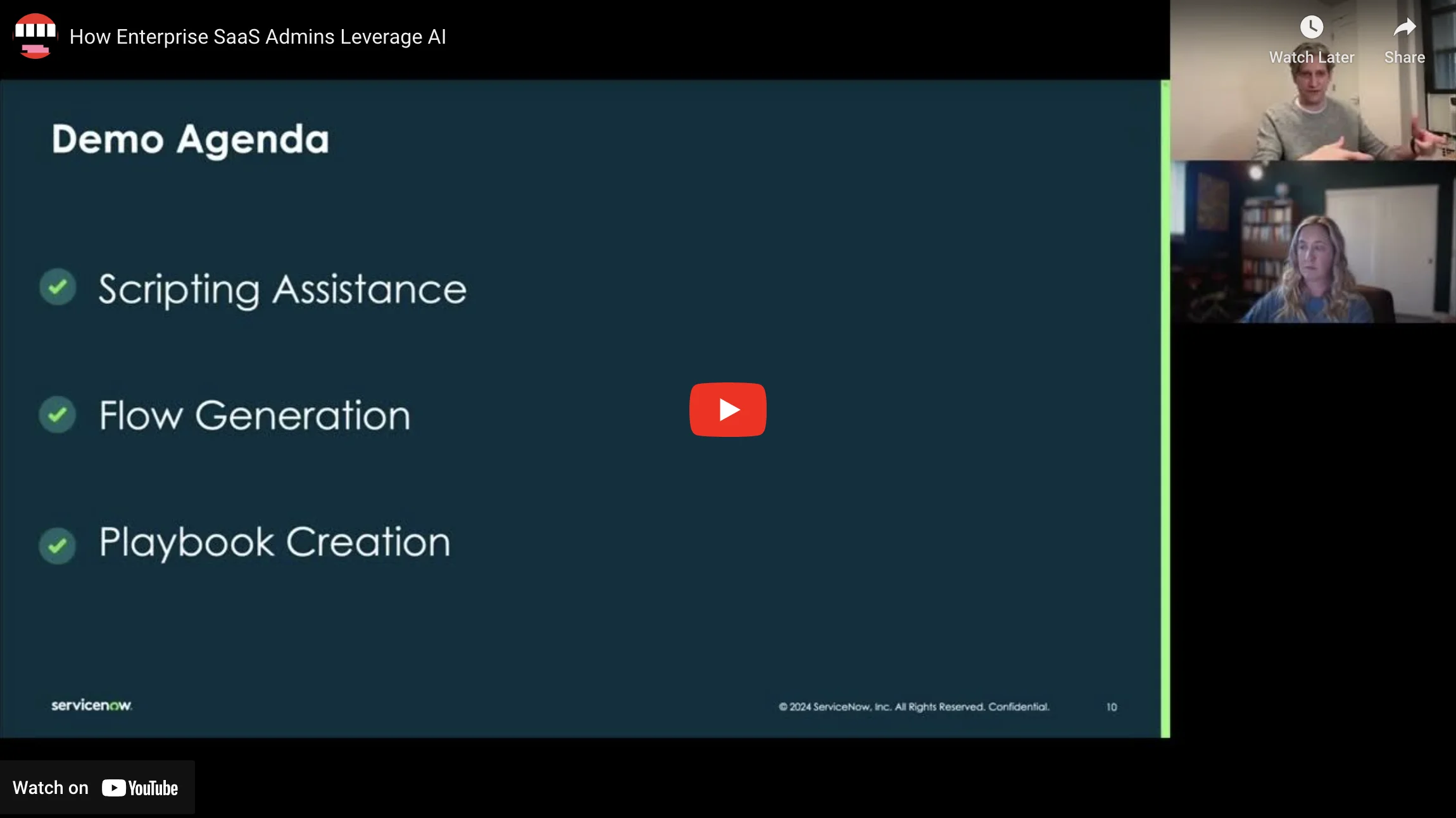
1. Helping IT admins and non-techy users create scripts
IT admins wanting customized solutions often have to wait ages to get the help of a developer. Ben shared how ServiceNow’s Now Assist overhauls this process, letting admins create scripts from a plain language AI prompt.
“I personally don’t know how to code. I can look at code and see what it’s doing, but I’m not a coder. That’s not my job,” Ben told us. “Thankfully with Now Assist, I’m able to actually go in and write the script that I need to do that calculation.”
Ben demoed this in action: he used a prompt describing how to calculate costs by comparing worker timesheets with their regular and overtime rates to instantly figure out the total cost based on hours submitted.
Now Assist generated a script draft, which Ben tweaked until it did exactly what he wanted.
2. Using flow generation to automate common tasks and save time
Ben then shifted to flow generation, demonstrating how ServiceNow’s Workflow Studio helps create micro-automations. These flows simplify repetitive tasks by automating actions based on triggers.
He ran us through an example of a contract renewal notification flow, instructing the AI to “Every day, check the contracts table for contracts that are expiring in the next 60 days and send an email to me.”
Very quickly, the AI built the flow’s framework, including triggers, conditions, and actions. While final tweaks were necessary—such as checking the emails were going to the right people—Ben emphasized how helpful this is for better collaboration.
“The fact that we can get this framework built out automatically is a huge time saver and it also makes the collaboration with the business owners that are asking for these changes a lot more smooth and a lot more easy to do.”
3. Creating playbooks for detailed business processes
Ben finished off by showing us how to create a playbook using ServiceNow, which he described as “a visual representation of a business process.”
“To actually get [a supplier] onboarded and vetted and approved—there’s a whole set of steps that they need to go through,” Ben explained.
Using Now Assist, Ben demonstrated how a playbook for supplier onboarding could be generated with a plain-language prompt. The resulting playbook included all the steps needed, like:
- Registration: Collecting supplier details through an internal form.
- Validation: Checking for duplicates in existing records, then enriching data through third-party sources like Dun & Bradstreet.
- Risk Assessment: Contacting the right people in the business to check whether suppliers comply with regulations and ethical standards.
- Final Tasks: Collecting banking and tax details from the approved suppliers.
Even though Ben needed to make some manual adjustments to set up triggers and integrations, he pointed out how much time was saved.
“Being able to collect requirements from the business stakeholder in plain English, plug it into a tool like Now Assist, and have it give you at least a framework to work off of—it just massively speeds up the development cycle time.”
AI and legal compliance
In the Q&A section of the workshop, Ben also touched on the issue of legal compliance—or as people often put it when talking to him, “how do we convince legal this is safe and secure?”
He explained that if you’re a customer looking to buy a generative AI solution for your business, your vendor “probably has resources to help you get over that hump with your legal team.” In particular, he emphasized that AI companies need to reassure users they won’t be using customer data to train their models.
Wrapping it up
One clear takeaway from our workshop with Ben George was how useful AI is to really large companies and enterprises, offering huge potential time and money savings. Using AI workflows means businesses can:
- Reduce costs, letting IT admins carry out customization tasks rather than relying on experienced software developers.
- Improve collaboration, e.g. between business teams and the IT admins.
- Increase efficiency, speeding up repetitive tasks—even complex ones, like vetting and onboarding new suppliers.
Whether you’re an IT admin, in procurement, or just curious about how large companies are using AI, Ben’s workshop is one you won’t want to miss. You can watch the full session (available to Pro Ben’s Bites members) here:
Liked this post? You may be interested in these: