The rise of the one-person product team
In the new wave of product building, do speed, taste, and iteration matter more than having a dev team?
Published 2025-04-17

When Lovable’s founder, Anton Osika, shared this tweet:
btw this is what lovable is used for pic.twitter.com/IE22ySNonB
— Anton Osika – eu/acc (@antonosika) April 13, 2025
It wasn’t so much the success of Lovable that caught my eye (though that is obviously incredible). It was Anton’s follow-up tweet where he mentioned what Lovable’s used for that I want to explore.
The work landscape is clearly changing. It used to take a team – designers, front-end devs, back-end devs, product managers, maybe even someone to wrangle Webflow or fiddle with Airtable integrations.
Now a single person with the right AI tool can build a decent version of something in an afternoon.
Weeks-long processes involving handoffs and meetings are getting compressed into a few prompts and a browser tab.
Let’s break down Anton’s tweet with a look at some real examples and how they might impact you going forward.
1. Product teams moving faster without waiting for design
Product organisations are bottlenecked by how quickly they validate what to change next. Previously designers took days to create static figma designs. Now every single employee can build prototypes instantly, validating or discarding ideas in minutes.
In a lot of product orgs, new ideas tend to stack up behind bottlenecks. Designers are busy and engineers often prioritise bigger launches. Ideas might be great but they just can’t move forward without going through the usual steps.
But put Lovable in the mix and everything changes. Well maybe not everything, but at least turning an idea into a product to test its viability, get feedback, or kickstart a conversation with users.
A landing page we designed and developed.
— Adam 🌿 Unroot.design (@unrootdesign) December 21, 2024
Full of micro interactions and high-quality design details.
Your thoughts? pic.twitter.com/FMhXlpRQjT
Okay, lovable is insane
— Meng To (@MengTo) March 18, 2025
I made this landing page with just a few prompts
Super good at generating unique-looking designs, turn screenshots to code and edit with tailwind. This is a designer's dream. pic.twitter.com/Y9tShS9D2D
When the barrier to building is low, more ideas get explored. And teams can learn what’s worth investing real time into a lot earlier.
🔮 What this means – my prediction
We’re going to see a rise in “concept validation teams” inside companies. Basically small groups that exist just to build and kill ideas at speed before they hit real development backlogs.
2. Startups launching without waiting for engineers
Founders launch MVPs and iterate 20x faster bypassing lengthy development cycles.
With tools like Lovable, solo founders or small teams don’t have to wait months for a first release. They can build a minimum viable product themselves, test the waters, and start learning from real users almost immediately.
Speed is a huge factor here, obviously. But it also means founders can afford to be wrong more often. When building is fast and cheap, trying again isn’t a crisis – it’s part of the process.
A non-technical founder just raised $500k for a software startup he built with Lovable, this is how:
— Anton Osika – eu/acc (@antonosika) April 4, 2025
//1 pic.twitter.com/hLfECi2tG7
WOW! 🤯
— Florin Pop 👨🏻💻 (@florinpop1705) April 11, 2025
In just 2 hours, I built an entire app from scratch that does interior design using AI.
No coding, just by prompting @lovable_dev step by step.
It has:
- authentication, db and storage with @supabase
- payments with @stripe for credits
- prompt enhancement with… pic.twitter.com/syelF8Mq8V
Here’s a great video by the way from Greg Isenberg’s podcast on building a SaaS with Lovable (and Supabase) – highly recommend watching.
🔮 What this means – my prediction
Even more solo founder startups will be profitable before making their first engineering hire, especially in vertical SaaS, internal tools, and AI-first products.
3. People building personal sites, event pages, and portfolios
Creators quickly produce visually appealing, responsive, and personalized websites without technical hassle.
Much of the momentum behind AI vibe coding tools is being driven by individual people creating personal projects super quick, without getting bogged down by hosting, templates, plugins, or front-end code.
The ability to create personal projects without being technical has been around for a long time now, thanks to the big no-code website builders we’ve all heard of – Squarespace, Wix et al – and lesser-known (but equally good, if not better) tools like Carrd.
But sometimes tools like these promise simplicity when what they actually deliver is hours (sometimes) of tweaking to get your site or page just how to want it.
With AI tools like Lovable, you can (often) prompt your way to perfection, removing the need for specific tool or technical knowledge.
Vibe-coded my personal portfolio website using @lovable_dev! I tried doing the same with Replit, V0, and Bolt, but Lovable has always been the most reliable. Do check it out and let me know what you think! Also reach out to collab! #buildinpublic https://t.co/aNPgETD1QX pic.twitter.com/pS8C2XGxJ4
— Kush Dhuvad (@kushdhuvad) April 3, 2025
🔮 What this means – my prediction
There’s an untapped opportunity to create hyper-targeted portfolio templates – not just designer or photographer portfolios, but ultra niche ones like personal trainer booking sites or virtual therapist portfolios built and shipped via AI tools.
4. Marketers shipping landing pages without waiting for designers and developers
Marketers instantly create, deploy, and optimize fully customizable landing pages, funnels, and entire websites.
Many marketers wanting to spin up landing pages on their own are turning to tools like Lovable. And not rough drafts or wireframes, but working versions ready to test with real traffic.
They can describe what they want and get a working version up and running quickly. And if they don’t like it, they can regenerate it, tweak it, create variations to test, without touching a line of code.
It’s a small but important shift that’s allowing more marketers to run experiments and move forward on their campaigns much faster.
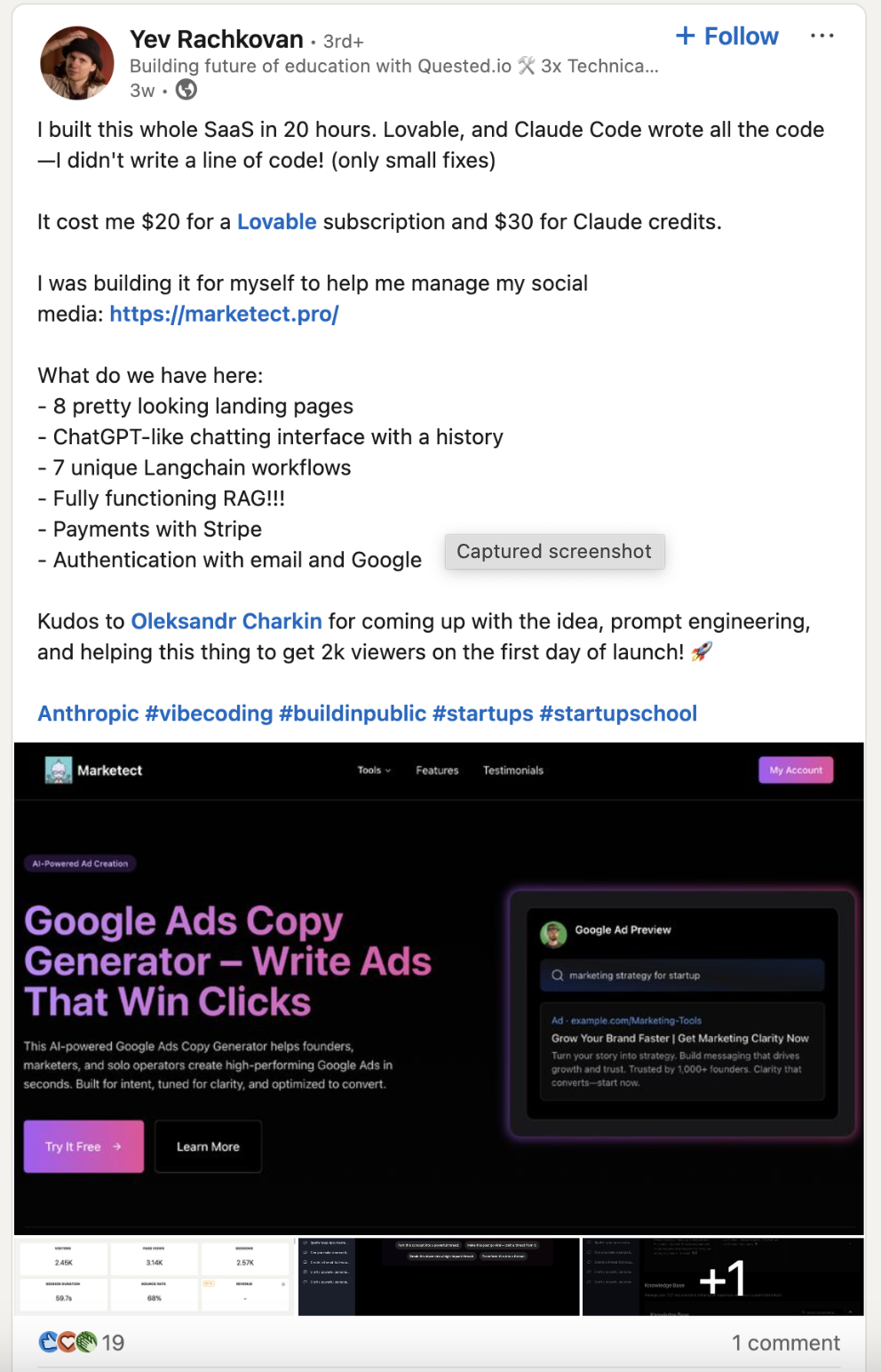
🔮 What this means – my prediction
Marketers who can build and launch their own experiments will quietly become 10x operators inside teams. The ones who can test fast will define how products are positioned.
5. Teams building internal tools and AI automations
Teams replace SaaS products with tailor made tools that have no monthly cost.
SaaS tools used at companies can get messy if not done well. Some are essential, of course, but some are workarounds, and others are sometimes just there because no one ever got around to replacing them.
Custom internal tools have been around for forever, but I think we can all agree they’re a bit of a luxury, thanks to the time and technical skill they take to build.
Hopefully by now you’re seeing a pattern! Lovable (and other AI tools) solves this problem quite dramatically. It’s not going to replace every SaaS overnight, but it can helps teams spot gaps where something lightweight and specific would do the job better.
This results in lower subscription bills but, more importantly, it gives teams more control over the tools they actually need, instead of adapting their work around tools they happen to have.
are you in sales and not a body language expert?
— zan (@thisiszanc) March 29, 2025
i just built a tool with @lovable_dev that gets you insights into your prospect's body language in real-time during your meeting.
works on all platforms (Meet, Zoom, Teams etc).
like & comment "access" if you'd like it free. pic.twitter.com/svsoJCMEHh
🔮 What this means – my prediction
In the next few years, companies will value internal tool-building skills the way they used to value spreadsheet skills.
6. Agencies shipping faster for clients
20 year olds are making $170K/month — building MVPs for startups, internal tools for enterprises, and beautiful frontends for anyone faster than ever.
You may have seen Billy Howell’s posts going viral on X recently. In essence he’s making a tonne of money spinning up apps (his agency is literally called Stupid Simple Apps) and selling them on sites like Upwork and Fiverr.
150,000 people watched my interview with @gregisenberg (link below)
— Billy Howell (@billyjhowell) April 8, 2025
1 guy watched it and sold a @Replit app 2 days later
only 1 in 150,000 copied my strategy 🤯
competition is a myth
you can just do things, but most people don't pic.twitter.com/RCAxFT2DW7
He’s teaching others how to do it, and by the looks of it, it’s working:
Booked my first $1000 client for vibe coding thanks to the @billyjhowell approach. 4 simple steps.
— Matt Deagle (@Elder_Deagle) April 12, 2025
There’s always been demand for people who can build quickly and make things look good – and agencies fill that gap. What’s changing is how fast that work can happen now.
It’s opening the door for a different kind of agency model: one that’s less about headcount and more about speed, taste, and iteration.
🔮 What this means – my prediction
Agencies building MVPs could become the new kingmakers for early-stage startups. They could launch 5 - 10 different MVP versions for client across different niches, audiences or product designs, testing and learning what works quicker than founders can.
Final thoughts
A lot of AI vibe coding tools still get framed as experiments – interesting, but not something that fundamentally changes how people work.
What I think is clear from these examples is that the change isn’t coming, it’s already here. The gap between idea and execution is getting narrower across teams, roles, and industries.
The people who spot it early – and get building – will be the ones who shape what comes next.
Written by Shanice.