Analyze and summarize financial statements
Use generative AI to quickly transform complex financial data into actionable insights.
2024-11-13
Financial analysis can be a daunting task, especially for those without extensive accounting backgrounds. This tutorial introduces a practical method for using ChatGPT to simplify and accelerate your company's financial analysis process. By leveraging AI, you can quickly transform complex financial data into actionable insights, saving time and reducing the risk of errors.
We'll walk through five key steps, from creating an initial financial overview to generating an executive summary. You'll learn how to use ChatGPT to calculate important ratios, analyze cash flows, and identify critical performance indicators. This approach allows you to focus on interpreting results and making informed decisions, rather than getting bogged down in calculations.
In this tutorial, you'll learn to:
- Generate a comprehensive financial overview using AI
- Perform ratio analysis to assess your company's health
- Analyze cash flows to understand your financial dynamics
- Identify and track key performance indicators
- Create an executive summary with strategic recommendations
Let’s dive in.
Step 1: Initial financial overview
The first step in our analysis involves creating a comprehensive snapshot of your company's financial status. This overview sets the stage for deeper analysis by highlighting the most significant aspects of your financial statements.
ChatGPT can quickly process and summarize complex financial data, providing you with a clear picture of your company's current standing. This AI-generated summary serves as a launching pad for further investigation, pointing out areas that may require closer examination.
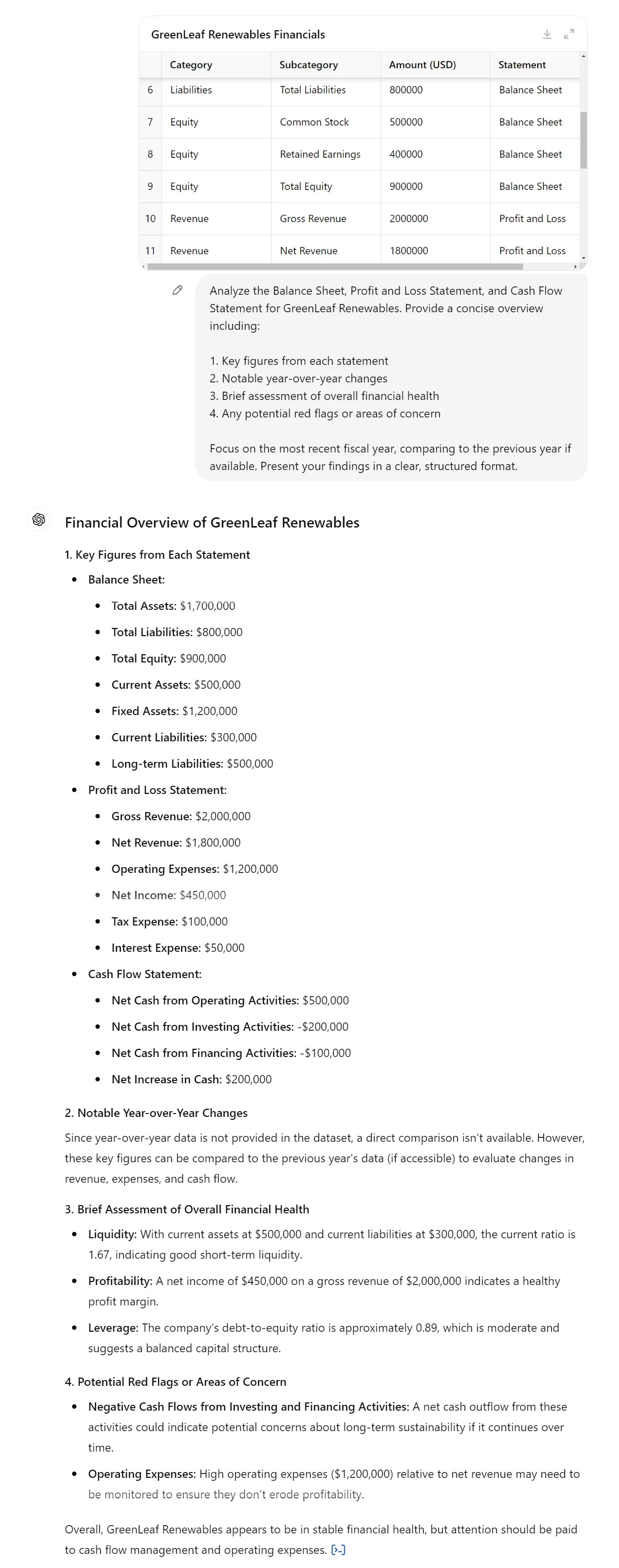
Use this prompt along with your balance sheet, profit and loss statement, and cash flow statements attached:
Analyze the Balance Sheet, Profit and Loss Statement, and Cash Flow Statement for [Company Name]. Provide a concise overview including:
1. Key figures from each statement
2. Notable year-over-year changes
3. Brief assessment of overall financial health
4. Any potential red flags or areas of concern
Focus on the most recent fiscal year, comparing to the previous year if available. Present your findings in a clear, structured format.
Step 2: Financial ratio analysis
With our initial overview complete, we now turn to financial ratios - key metrics that provide insight into various aspects of your company's performance. By leveraging ChatGPT for this analysis, we can quickly calculate and interpret a wide range of ratios, saving time and reducing the chance of computational errors.
These ratios offer a standardized way to evaluate your company's financial health and compare it to industry benchmarks. They can reveal strengths and weaknesses that might not be immediately apparent from looking at raw financial data alone.
Use this prompt:
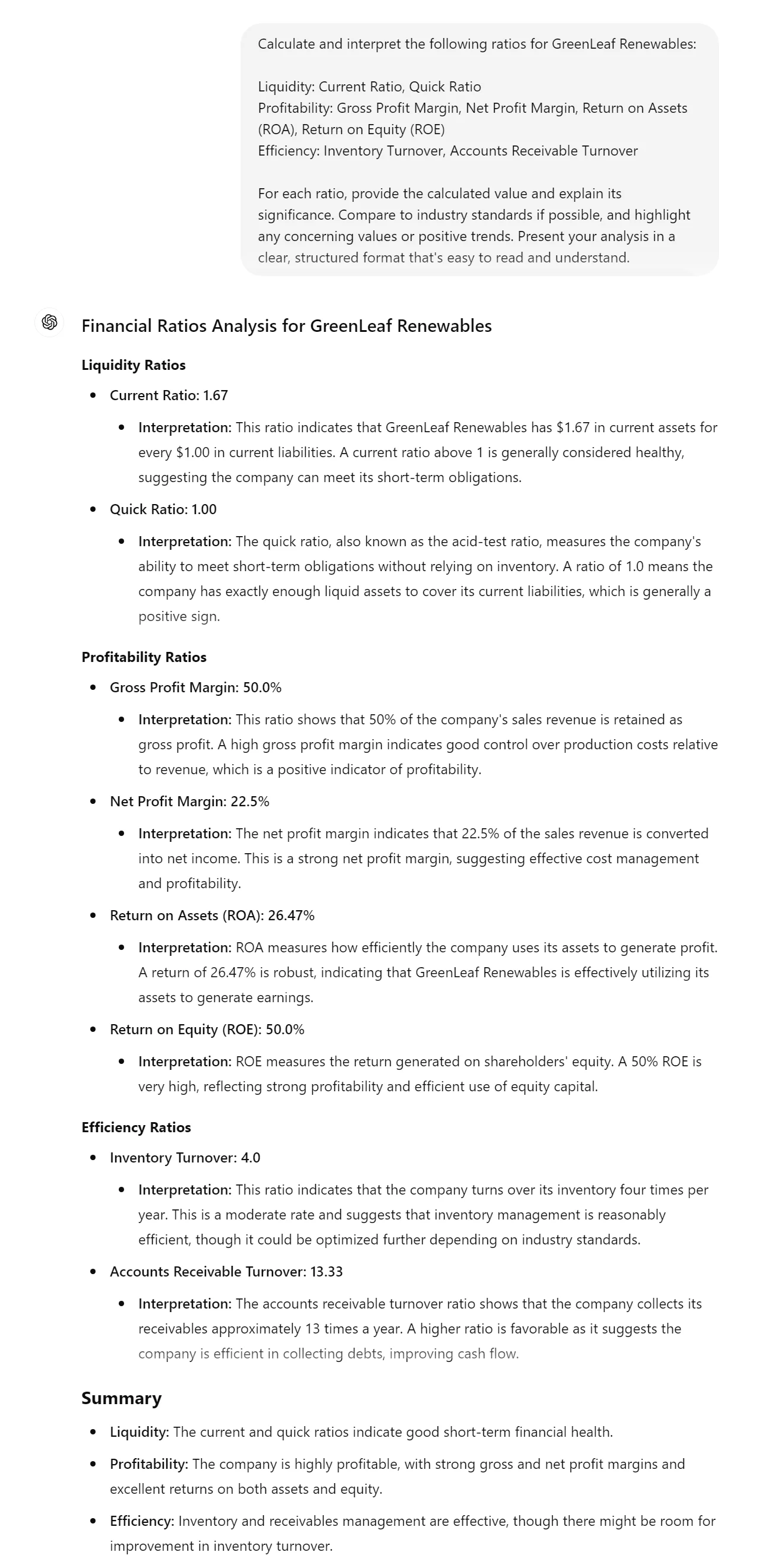
Calculate and interpret the following ratios for [Company Name]:
Liquidity: Current Ratio, Quick RatioProfitability: Gross Profit Margin, Net Profit Margin, Return on Assets (ROA), Return on Equity (ROE)Efficiency: Inventory Turnover, Accounts Receivable Turnover
For each ratio, provide the calculated value and explain its significance. Compare to industry standards if possible, and highlight any concerning values or positive trends. Present your analysis in a clear, structured format that's easy to read and understand.
Step 3: Cash flow analysis
Next, we delve into the lifeblood of your business - cash flow. This step focuses on understanding how money moves through your company, providing crucial insights into your operational efficiency and financial stability.
By using ChatGPT to analyze your cash flow statement, we can quickly identify patterns and potential issues in your company's cash management. This analysis is vital for assessing your company's ability to generate cash from its core business, fund its operations, and finance growth.
Use this prompt:
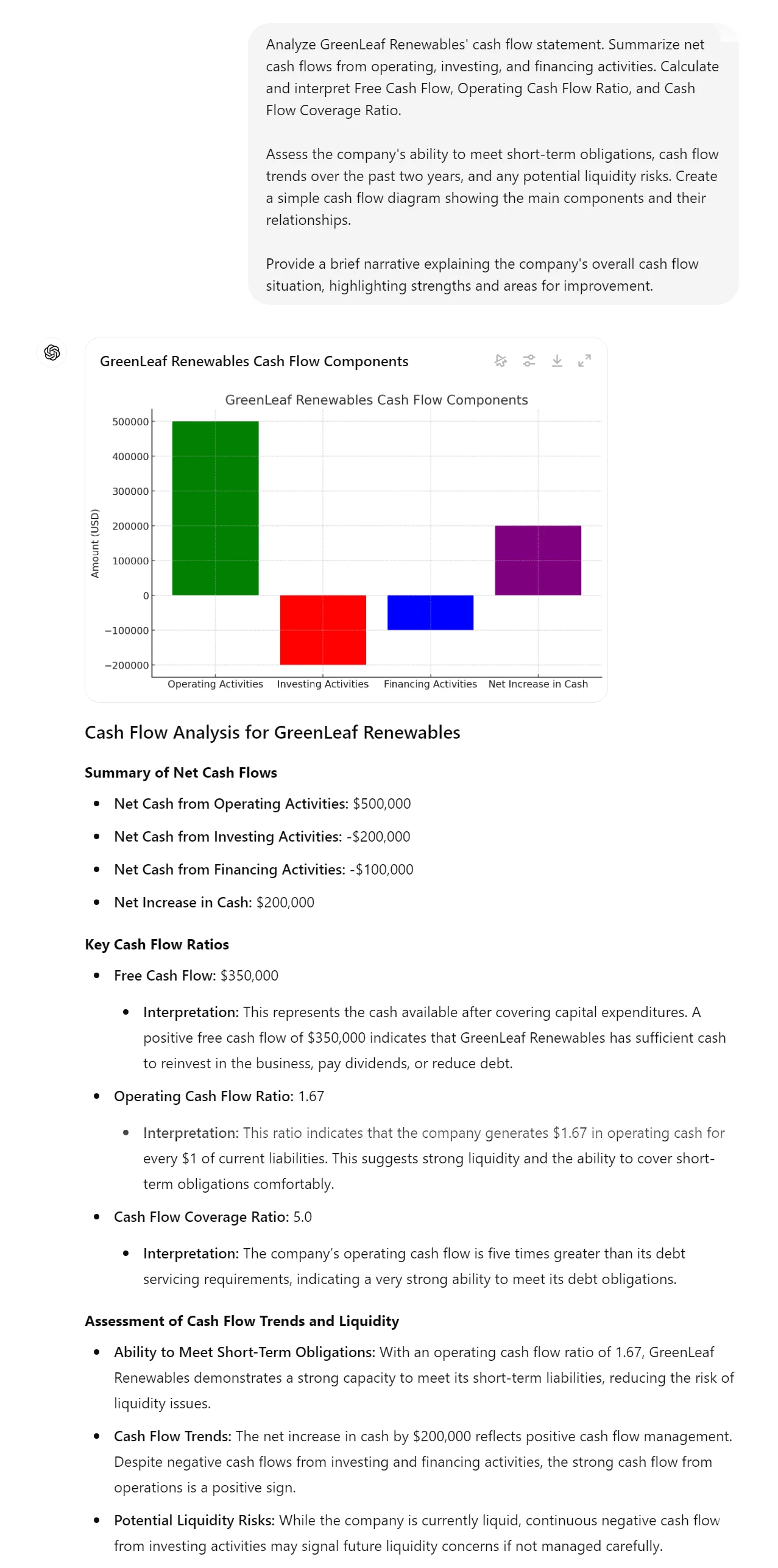
Analyze [Company Name]'s cash flow statement. Summarize net cash flows from operating, investing, and financing activities. Calculate and interpret Free Cash Flow, Operating Cash Flow Ratio, and Cash Flow Coverage Ratio.
Assess the company's ability to meet short-term obligations, cash flow trends over the past two years, and any potential liquidity risks. Create a simple cash flow diagram showing the main components and their relationships.
Provide a brief narrative explaining the company's overall cash flow situation, highlighting strengths and areas for improvement.
Step 4: Key performance indicators and trends
In this phase, we shift our focus to identifying and analyzing the most critical metrics for your company's success. By leveraging AI to process large amounts of financial data, we can pinpoint key performance indicators (KPIs) that are most relevant to your industry and business model.
This step goes beyond static numbers, examining how these KPIs have changed over time to reveal important trends in your company's performance. By comparing your KPIs to industry benchmarks, we gain valuable context for your company's standing in the market.
Use this prompt:
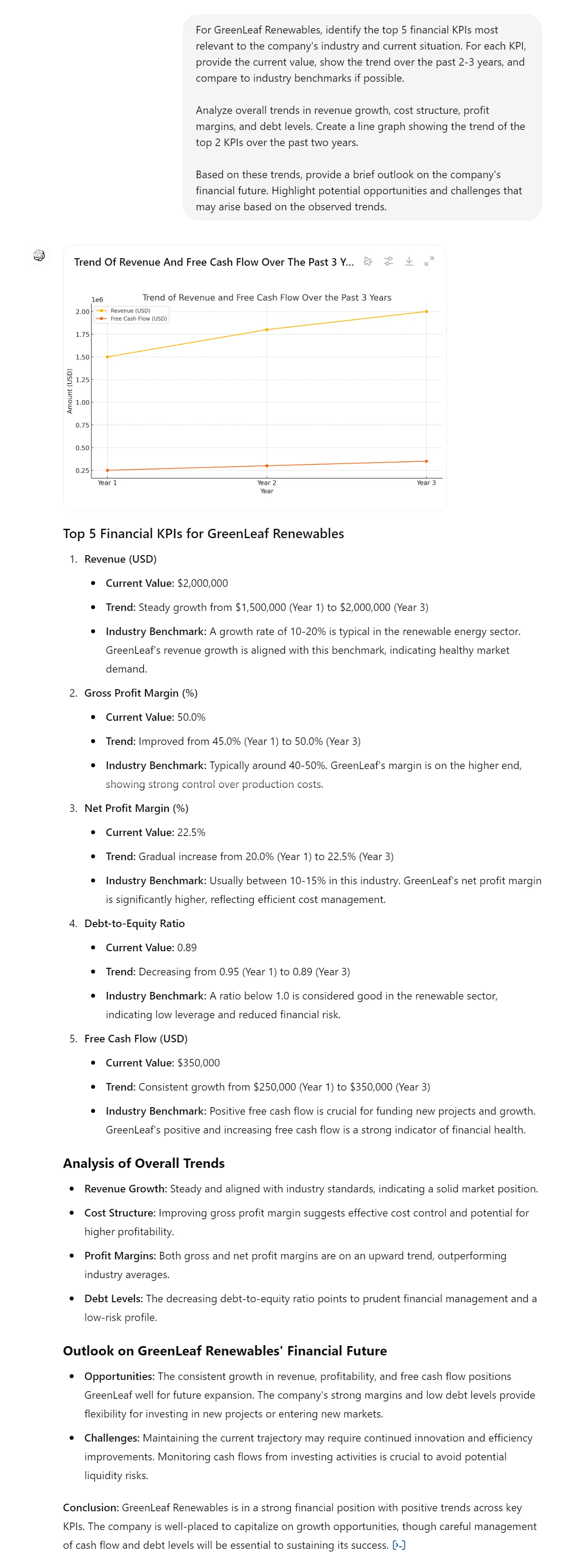
For [Company Name], identify the top 5 financial KPIs most relevant to the company's industry and current situation. For each KPI, provide the current value, show the trend over the past 2-3 years, and compare to industry benchmarks if possible.
Analyze overall trends in revenue growth, cost structure, profit margins, and debt levels. Create a line graph showing the trend of the top 2 KPIs over the past two years.
Based on these trends, provide a brief outlook on the company's financial future. Highlight potential opportunities and challenges that may arise based on the observed trends.
Step 5: Executive summary
The final step in our analysis involves distilling all of our findings into a concise, actionable report. This executive summary serves as a roadmap, guiding stakeholders through the key insights uncovered in our analysis and providing clear directions for future strategy.
This step transforms our detailed financial analysis into a strategic tool for decision-making.
Use this prompt:
Create an executive summary for [Company Name] that includes:
1. Brief overview of financial performance
2. Key financial highlights and growth rates
3. Summary of financial health (liquidity, solvency, cash flow)
4. Top 3 KPIs and their performance compared to industry benchmarks
5. Major trends identified and their potential impact
6. SWOT analysis based on the financial analysis
7. 3-5 actionable recommendations to improve financial performance
Use clear, stakeholder-friendly language and limit the summary to 500 words. Present the information in a logical flow that tells a coherent story about the company's financial situation and future prospects.
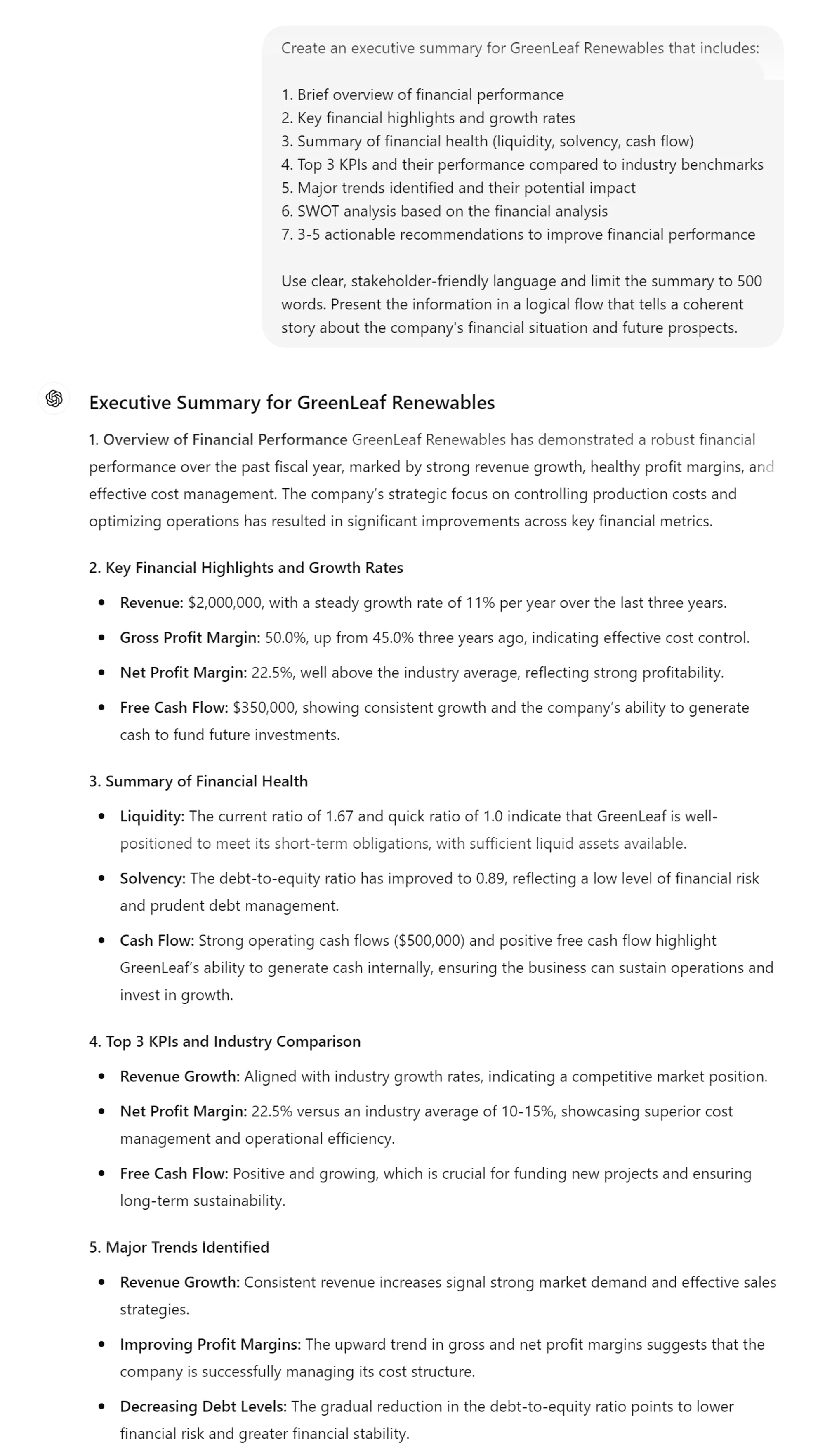
This method allows for a comprehensive examination of your financial position, helping you uncover insights that might otherwise remain hidden. As you integrate this process into your regular financial reviews, you'll find it an invaluable tool for informed decision-making and strategic planning.
This tutorial was created by Tanmay.