Building a brand style guide that drives business growth
How to use AI to develop a comprehensive brand style guide that aligns strategy, messaging, and design.
2024-11-13
Creating a brand style guide is not just about making sure your logo looks good on everything. It’s a strategic blueprint that shapes how your business communicates, connects, and grows.
This tutorial focuses on brand strategy, messaging, and positioning to form a comprehensive, strategic approach to branding. It’s the deep work that precludes designing and putting together a style guide. We’ll be using ChatGPT, but you can use other AI tools like Claude or Gemini too.
By the end of the tutorial, you’ll have built a comprehensive brand style guide that:
- Ensures consistency
- Aligns with business goals
- Maintains brand integrity across all channels
You’ll learn how AI can can improve not only the efficiency but the depth and strategic impact of branding work.
Let’s get into it.
Step 1: Understanding the purpose of a brand style guide in strategy
Before diving into the specifics, let’s set the scene a bit. We’ll ask ChatGPT to clarify the broader role of a brand style guide.
We know it’s not just about logos or colour palettes. It's a strategic tool that ensures every piece of communication—from emails to social media—reflects your brand's values and goals. But by defining details and best practises, we’ll have a helpful framework to keep in mind as we move through the next steps.
Open up ChatGPT and use this prompt:
Explain how a brand style guide can help a company maintain consistency and build trust across various customer touchpoints. Include why it’s important for long-term brand growth.
This is the answer ChatGPT gave me:
.webp)
.webp)
.webp)
Another great prompt to use at this stage is (replace the square brackets with your own industry):
List the strategic elements a brand style guide should contain for a company focused on [insert industry], aiming to build long-term customer loyalty.
.webp)
.webp)
.webp)
ChatGPT’s answer cropped for demo purposes
ChatGPT will highlight the key elements to consider when putting together a brand style guide for a company in your industry.
Let’s now work with ChatGPT to develop some of those elements.
Step 2: Developing brand foundations: Mission, vision, and core values
Every great brand style guide starts with a clear understanding of the company’s mission, vision, and values. These foundations will influence not only your messaging but how you present yourself visually and emotionally to your audience.
If you don’t have these core elements for your brand defined yet, you can use AI to help shape them. You'll need to provide specifics about your company in the following prompt:
Create a mission, vision, and values statement for my [industry] company, [company name]. The company should focus on [insert company focus, e.g., sustainability, innovation, customer-first approach], and appeal to [insert target audience demographic]
.webp)
.webp)
Once you’ve generated these foundational elements, add them to the top of your brand style guide. They will serve as your North Star for all the work to come. Every element of the style guide should tie back to these core brand pillars.
For now, I’m adding everything to a Google doc, like this:
.webp)
Step 3: Aligning the brand with target audience personas
Your messaging and tone need to align with who you're talking to. In this step, we’ll develop audience personas to ensure your content resonates with your intended market. This is crucial for tailoring your communication, and the AI will help you create detailed audience segments.
If you’ve already done work on target personas and have them defined, you can skip ahead to step 4 of the tutorial.
If you’re yet to generate personas, use this prompt:
Generate detailed audience personas for [your company], focusing on [insert target audience details: e.g., urban professionals, millennials, high-net-worth individuals]. Include demographic information, interests, and challenges they face.
.webp)
.webp)
.webp)
Let’s update the Google doc to reflect our audience. I’m only adding the first 3 personas since 5 feels like too much.
.webp)
Step 4: Brand personality and voice: Creating a consistent tone
Now that we know who we’re targeting, we can develop a tone. In other words, how you talk as a brand. Your brand personality and voice should reflect your core values and resonate with your target audience.
Continuing our thread with ChatGPT, prompt this:
How should a [industry] brand targeting these personas adjust its tone, style, and messaging to connect with that audience effectively?
(If you’ve already defined your audience personas, attach a doc containing full details of them).
.webp)
.webp)
.webp)
ChatGPT made some recommendations for tone based on Pinnacle Pay’s audience personas. The main suggestions I’m going to pay attention to are:
- Trustworthy
- Professional
- Approachable
Let’s use everything we have so far and ask ChatGPT to define a brand personality and tone of voice:
Now we’ve established a mission, vision, and values for [company name], and defined a brand personality and tone of voice. The brand should be [insert adjectives, e.g., authoritative, friendly, approachable] and appeal to [insert audience demographic]. Provide specific examples of the tone for social media, email, and website content.
.webp)
.webp)
By asking the AI for specific examples, it can help us understand how our brand tone should be adapted for different contexts (formal vs. casual, business-to-business vs. business-to-consumer), ensuring consistency.
Take ChatGPT’s suggestions and add them to your style guide notes, refining however suits your company.
.webp)
Step 5: Strategic brand positioning and messaging architecture
Next, let’s establish your brand positioning. This is about defining where your brand sits in the marketplace and how it differentiates from competitors. We’ll also build a messaging hierarchy so that every piece of content—from blog posts to product descriptions—supports this position.
At this point, I like to give ChatGPT a copy of the Google doc I’ve been adding to, so it can see a consolidated version of everything we’ve discussed—and be aware of any adjustments I’ve made.
Prompt:
I am attaching a copy of the style guide you have helped me create so far. Read it. Now I’d like you to generate a brand positioning statement for [your company].
The brand should stand out because [insert differentiator, e.g., innovation, luxury, sustainability] and appeal to [insert target audience]. Then, outline a messaging hierarchy that prioritises key brand messages across different platforms.
.webp)
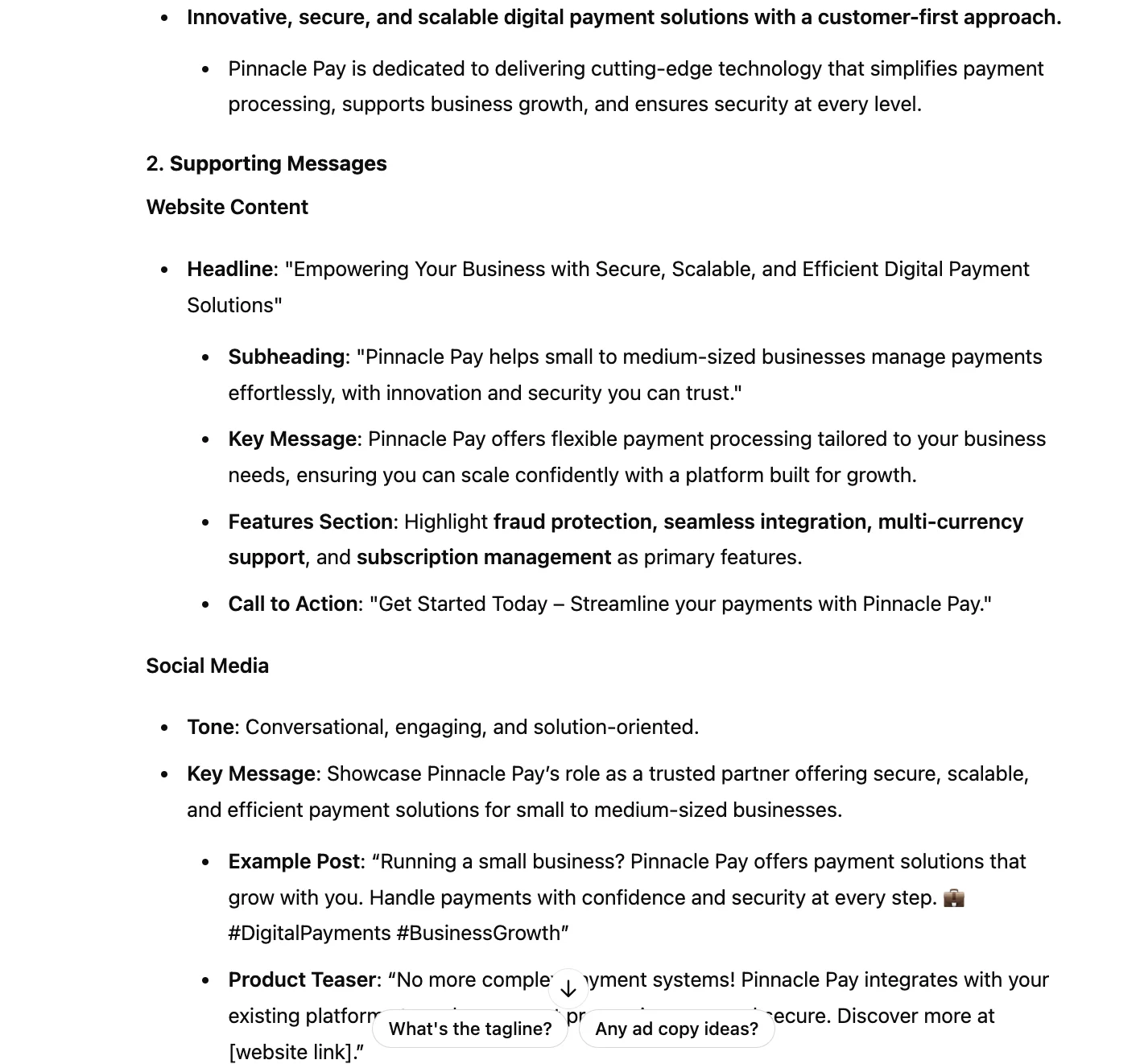
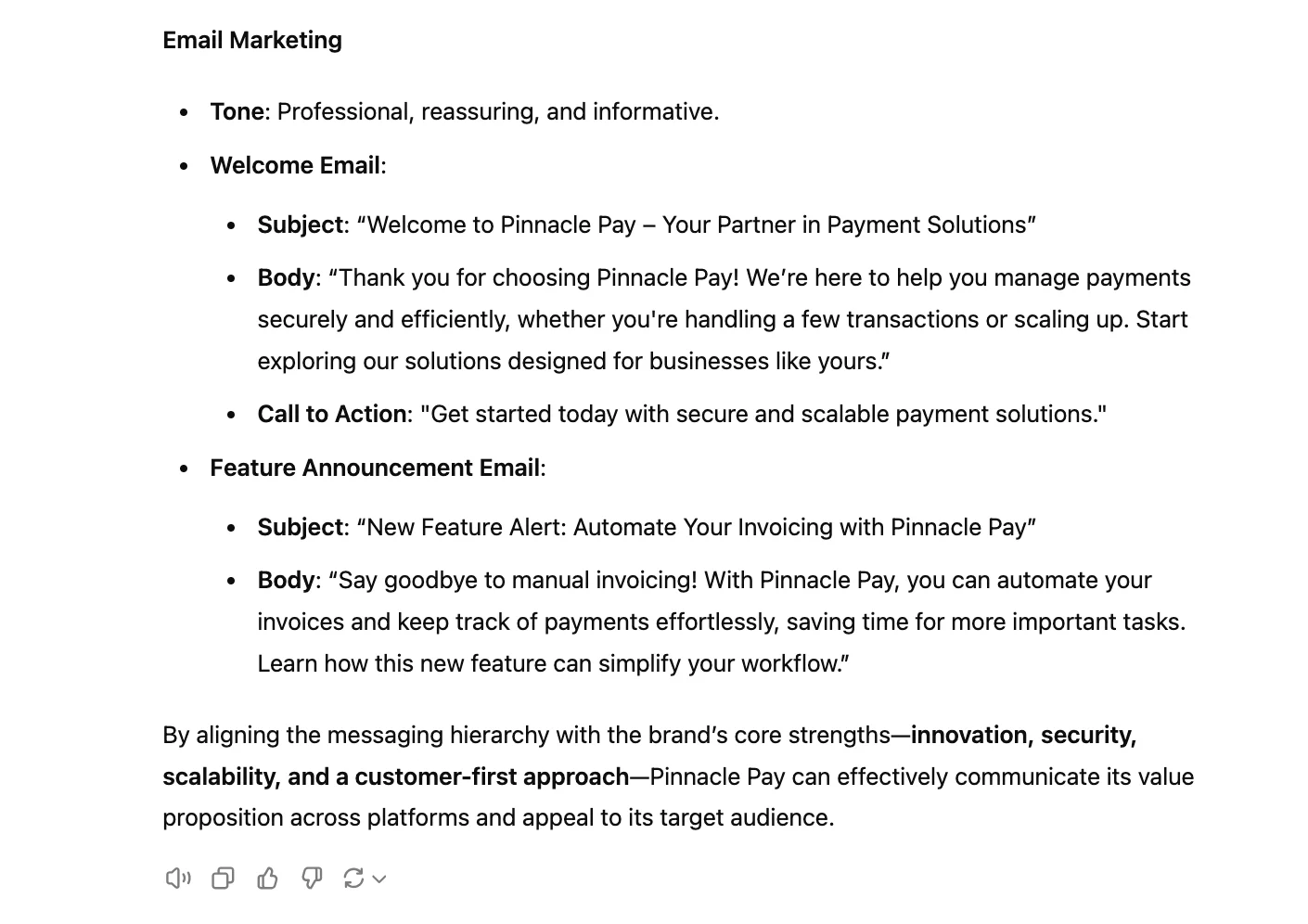
Refine as needed. Once complete, add this under a new section titled “Brand Positioning & Messaging” in your style guide. You’ll use this to shape all communications, ensuring consistent brand positioning.
Step 6: Further developing your brand guidelines
Other strategic elements that are optional but that you might want to consider adding to your style guide include:
- Behavioural guidelines - for brand representatives (sales teams or customer support) to follow when interacting with customers.
- Content pillars and guidelines - for blogs, FAQs, or educational materials.
- Guidelines for maintaining brand consistency - how the brand should appear across all platforms.
- Data visualisation standards - guidelines on presenting financial data, charts, and graphs
- Security and compliance messaging - potentially essential depending on your industry.
- Accessibility standards - how the brand will ensure inclusivity across digital platforms.
- Brand voice in crisis communication - how to communicate when issues arise, e.g. in times of financial instability, data breaches, or service outages.
You can continue using ChatGPT to aid with all of these steps.
Step 7: More actions to take
Now you’ve done the strategic work for developing your brand, here are more steps you can take:
Design visuals
All the elements you’ve established using this tutorial will help inform what your brand looks like visually. At a minimum, you’ll need:
- Logo
- Colour palette
- Typography
- Imagery and Iconography
We highly recommend handing these tasks off to a professional designer, who can take your style guide doc you built throughout this tutorial and develop a full brand guidelines deck.
Create on-brand decks
Thanks to AI, making sure slide decks feel on-brand is easy. Using a tool like Gamma, you can simply upload your brand guidelines and the AI will transform it into a stunning presentation.
Measure brand impact and adjust strategy
A brand style guide is a living document—it needs to evolve as your business and market change. To ensure ongoing relevance, you’ll want to establish ways to measure brand impact and adjust your strategy when necessary.
Here’s an initial prompt you can use in ChatGPT to track the effectiveness of brand messaging and customer engagement, adjusting strategies as needed.
List Key Performance Indicators (KPIs) that [your company] can use to measure brand consistency and effectiveness. Include suggestions for how to adjust the brand strategy based on feedback or market changes.
Once you complete all these steps, you’ll have a comprehensive, strategic brand style guide that not only covers visuals but also provides clear guidelines for communication, tone, audience engagement, and brand evolution. The guide will be a tool to help everyone in your organisation stay on-brand, from marketing to customer support, and ensure that your brand is both consistent and compelling across every touchpoint.
Remember: A strong brand strategy is the backbone of all successful communication!
This tutorial was created by Shanice.