Conducting product viability analysis
Leverage ChatGPT to assess the feasibility and potential success of new product ideas.
2024-11-13
Launching a new product involves significant risk, but with a thorough viability analysis, you can confidently assess market potential, competition, and financial feasibility. ChatGPT offers a streamlined, cost-effective method to conduct this essential analysis, saving time and resources.
In this tutorial, you will learn how to:
- Define your product concept with precision
- Analyze market demand and identify emerging trends
- Assess the competition and articulate your unique differentiation
- Estimate costs, potential revenues, and profitability
- Evaluate regulatory and compliance requirements
- Synthesize findings for an overall viability assessment
By the end of this tutorial, you'll have a structured, data-driven approach to determine if your product idea is worth pursuing.
Step 1: Define your product concept
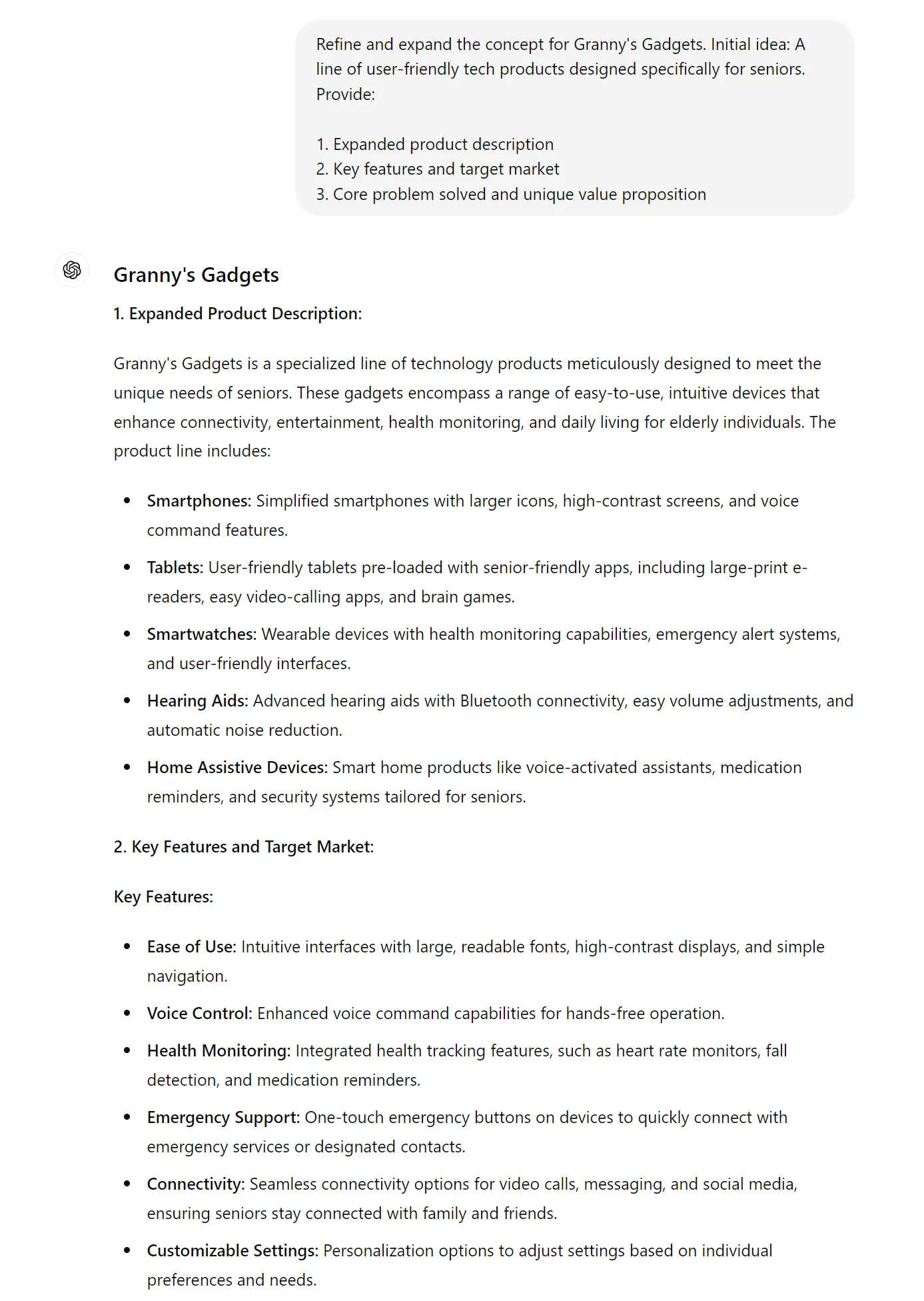
Start by clearly articulating your product idea. A well-defined concept is crucial for an accurate analysis. Use ChatGPT to refine and expand your initial idea, ensuring all key aspects are considered.
Prompt:
Refine and expand the concept for [your product name]. Initial idea: [brief description]. Provide:
1. Expanded product description
2. Key features and target market
3. Core problem solved and unique value proposition
.webp)
Step 2: Analyze market demand and trends
Now, we'll assess the potential market for your product. This step helps you understand if there's sufficient demand and how the market is evolving. ChatGPT will provide insights based on your product description.
Prompt:
Now, based on the refined product concept, analyze market demand for it. Include:
1. Estimated market size and growth rate
2. Key industry trends
3. Potential challenges or opportunities
.webp)
.webp)
Step 3: Assess competition and differentiation
Understanding your competition is crucial for determining product viability. In this step, we'll identify key competitors and analyze how your product stands out.
Prompt:
For [your product name], provide:
1. List of top 3-5 competitors with brief descriptions
2. Analysis of how it differentiates from competitors
3. Unique features or benefits
.webp)
.webp)
Step 4: Estimate costs and potential revenues
In this step, we'll examine the financial viability of your product. We'll create a projection of costs and revenues over time, visualize the data, and analyze the potential profitability. This will help you determine if the product is financially feasible.
Generating financial estimates
Create a CSV file with projected monthly data for the first year including the following columns:
1. Month
2. Units Sold
3. Revenue
4. Production Costs
5. Marketing Costs
6. Total Costs
7. Profit
Use these assumptions:
1. Production cost per unit: [your estimate]
2. Selling price: [your estimate]
3. Monthly growth rate in units sold: [your estimate]
4. Monthly marketing budget: [your estimate]
.webp)
Visualizing estimated financials
Now, let's create a visualization of this data:
Using the CSV data provided, create a line chart and bar graph showing the following over the 12-month period:
1. Revenue
2. Total Costs
3. Profit
4. Break-even point
Label the axes appropriately and include a legend.
.webp)
Analyzing the financial projection
Finally, let's analyze this financial projection:
Based on the financial projection and visualization, provide:
1. Projected total revenue for the year
2. Projected total costs for the year
3. Projected profit (or loss) for the year
4. Month when the product is expected to break even (if applicable)
5. Expected capital needed to setup and maintain product for 2 years
6. Brief analysis of the financial viability based on these projections
.webp)
Step 5: Evaluate regulatory and compliance requirements
This step helps identify potential legal or regulatory hurdles your product might face. Understanding these requirements early can save significant time and resources later in the development process.
Prompt:
For [your product name] in [your industry], provide:
1. Relevant industry-specific regulations
2. Potential compliance requirements (e.g., data privacy, safety standards)
3. Estimated impact on product viability
.webp)
.webp)
Step 6: Synthesize overall product viability
In this final step, we'll bring all the information together for a comprehensive viability assessment. This holistic view will help you make an informed decision about moving forward with your product idea.
Use this final prompt:
Now, based on all the areas we have discussed, assess the overall viability of product. Include:
1. Key strengths and potential risks
2. Areas needing further investigation
3. Overall viability score (1-10) with brief justification
4. Recommended next steps
.webp)
.webp)
Remember, this analysis is a starting point - as you gather more data and feedback, continue to refine your assessment. Armed with this information, you're now better equipped to decide whether to move forward with your product idea or pivot to a new concept. Who knows? Your next gadget might just be the thing that finally gets Granny to stop asking you how to unmute herself on video calls! 😃
This tutorial was created by Tanmay.