Develop a learning & development strategy
Learn how to use AI to create learning programs that align capabilities with organizational goals.
2024-12-05
Welcome to the first lesson of our course on Executing a successful learning & development strategy using AI.
In this tutorial, you’ll learn what makes an effective L&D strategy and use Claude to help you outline your own. These are the steps we’ll follow:
- Understand the L&D landscape
- Analyze your current business strategy
- Identify critical capabilities for business success
- Draft an aligned L&D strategy
- Create an aligned L&D strategy
McKinsey's research suggests that a significant percentage of market capitalization in public companies is based on intangible assets—skilled employees, exceptional leaders, and knowledge. Yet, only 40% of companies say their learning strategy is aligned with business goals, leaving a vast opportunity for improvement.
We're going to make sure you're in that 40% – or better yet, leading the pack. In this course, we'll explore a fresh take on L&D strategy. We'll dive into how AI can help us build learning programs that really click with what your company's trying to achieve, create persona-based learning paths and measure impact.
Let's get to it.
Understanding the L&D landscape
Before we jump into creating a L&D strategy, let's get our bearings in the current L&D landscape and understand why it matters so much.
Learning and Development is a strategic process that enhances employee skills, knowledge, and capabilities to drive both individual and organizational performance. In our knowledge-based economy, L&D has evolved from a support function to a key driver of business success.
The link between L&D and business performance is powerful:
- Skill development: Effective L&D ensures your team has the skills needed to drive growth and innovation.
- Employee engagement: Offering learning opportunities boosts satisfaction and retention, cutting turnover costs.
- Adaptability: A strong L&D function helps your organization pivot quickly, upskilling or reskilling employees in response to market changes or new technologies.
- Talent attraction: Robust L&D programs can be a key differentiator in attracting top talent.
- Cultural alignment: L&D initiatives can reinforce company values and build a strong organizational culture.
Key components of an effective L&D strategy
Now that we've got a handle on the L&D landscape, let's break down the key components that make an L&D strategy truly effective. These elements ensure your strategy aligns with business objectives and delivers measurable results.
- Alignment with business strategy: This is the big one. Your L&D initiatives should directly support your company's strategic goals and priorities. If they don't, you're just spinning your wheels.
- Budget and resource allocation: You need appropriate financial and human resources to support the implementation of your L&D initiatives. Great ideas without resources to back them up are just daydreams.
- Clear vision and objectives: Your L&D strategy needs a well-defined vision that aligns with your organization's mission and values. This isn't just a feel-good statement – it's the North Star that guides all your L&D initiatives.
- Measurement and evaluation: You need robust metrics and analytics to assess the impact of your L&D initiatives on individual and organizational performance. If you can't measure it, you can't improve it.
What are Claude Artifacts?
In this course, we'll frequently use Claude Artifacts - a powerful feature that enhances how we create and present L&D strategies and analyses. Artifacts are modular components that allow us to generate interactive visualizations, custom code, formatted documents, and data analyses directly within our conversations with Claude.
Whether we're analyzing capability gaps, creating assessment tools, or measuring program effectiveness, Artifacts help us present complex information clearly and professionally. You'll see them in action throughout the course, particularly when we're working with data visualizations, creating implementation tools, or generating detailed reports.
Step 1: Analyze your current business strategy
Now that we've got a solid foundation in L&D strategy, it's time to roll up our sleeves and dig into your specific business strategy. We're going to use Claude to analyze your current business strategy and identify key areas where L&D can make a significant impact.
Let's start by prompting Claude to analyze your business strategy. Upload it as a document along with the following prompt:
Analyze the following business strategy document. Provide a structured summary including:
1. Main business objectives
2. Key market trends
3. Competitive advantages
4. Major challenges
5. Areas where employee skills and knowledge will be crucial for success
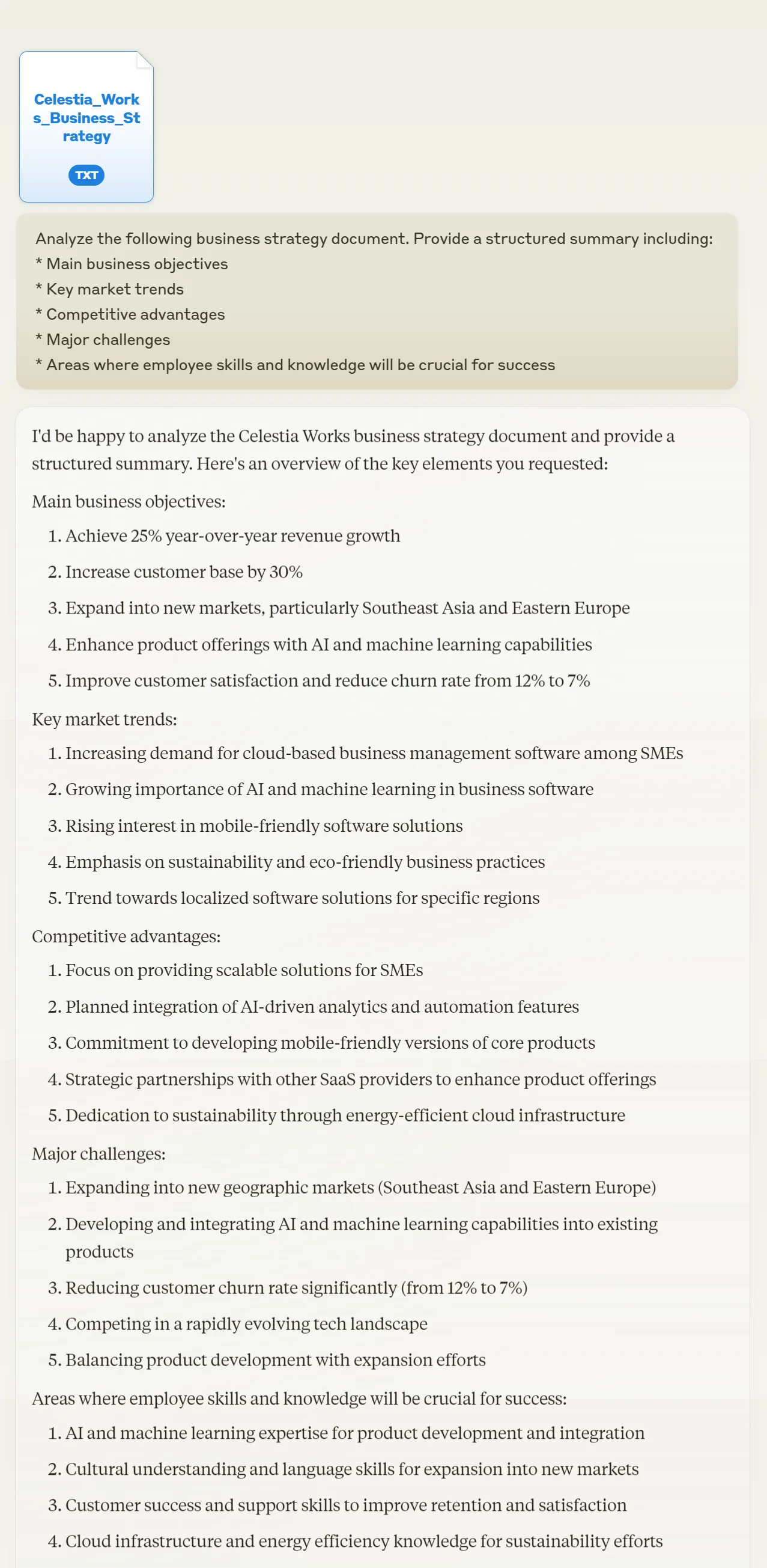
Claude will provide a structured summary of your business strategy, highlighting the key areas that will inform our L&D strategy. Take some time to review this output and identify the most critical elements that our L&D strategy should address.
Step 2: Identify critical capabilities for business success
With our business strategy analysis in hand, we're now going to pinpoint the essential skills and knowledge areas your workforce needs to execute this strategy successfully. This step is crucial in ensuring our L&D strategy focuses on developing the capabilities that will have the biggest impact on your business success.
Let's prompt Claude to identify these critical capabilities:
Based on the business strategy analysis from the previous step, generate a list of essential capabilities. For each capability:
1. Explain its relevance to our business objectives
2. Suggest potential learning interventions to develop this capability
3. Indicate the potential impact on business performance
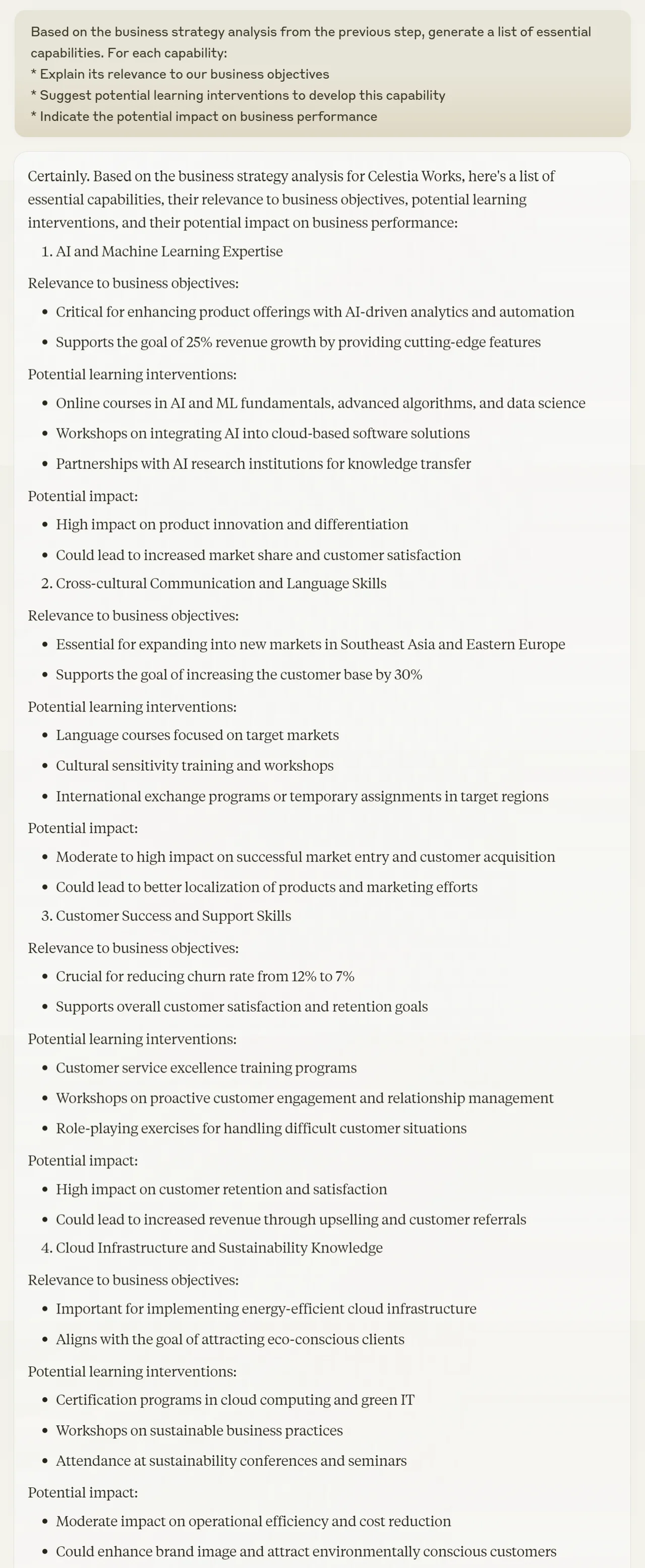
This list of critical capabilities is your L&D strategy's bullseye. It ensures you're not just training for the sake of training, but developing the specific skills and knowledge that will drive your business forward.
Step 3: Draft an aligned L&D strategy
We've done the groundwork. We understand the L&D landscape, we've analyzed your business strategy, and we've identified the critical capabilities your organization needs. Now it's time to bring it all together and draft an L&D strategy that's perfectly aligned with your business goals.
Let's prompt Claude to help us create an initial draft:
Based on our business strategy analysis and the list of critical capabilities, create an initial draft of our L&D strategy. Include:
1. Vision statement
2. Strategic objectives
3. Learning methods and technologies
4. Budget and resource requirements
Ensure that each element clearly aligns with our business goals.
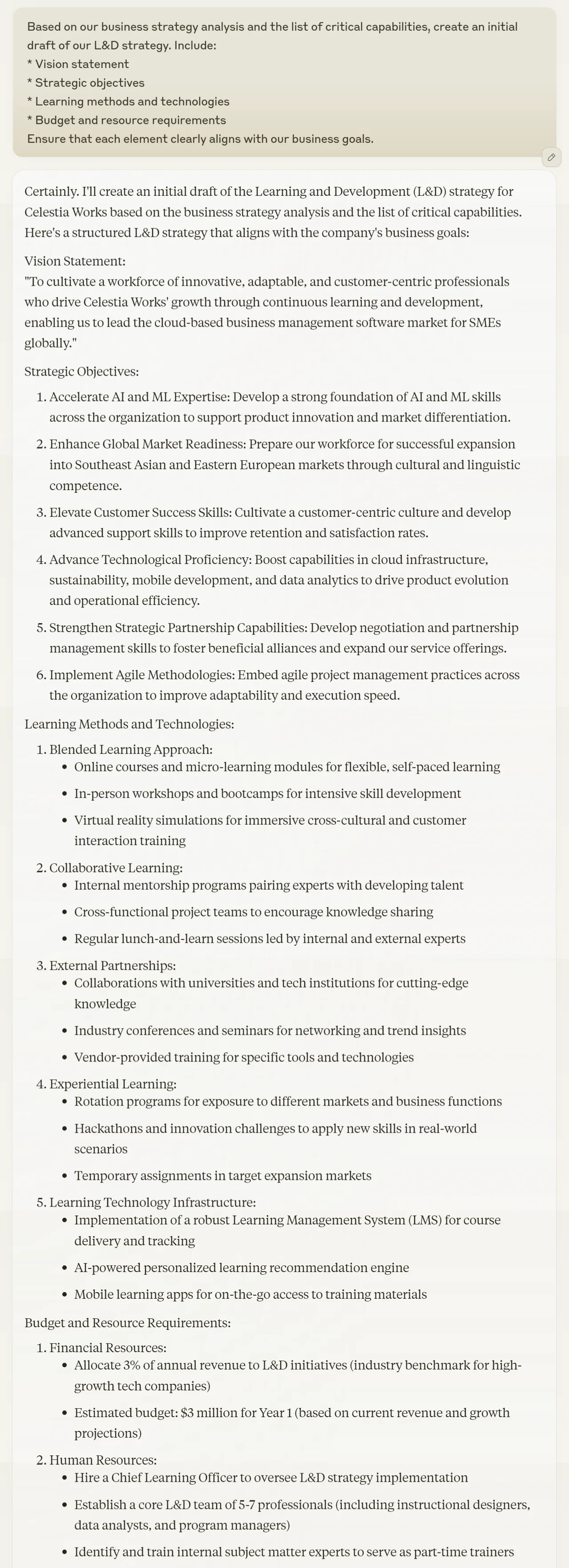
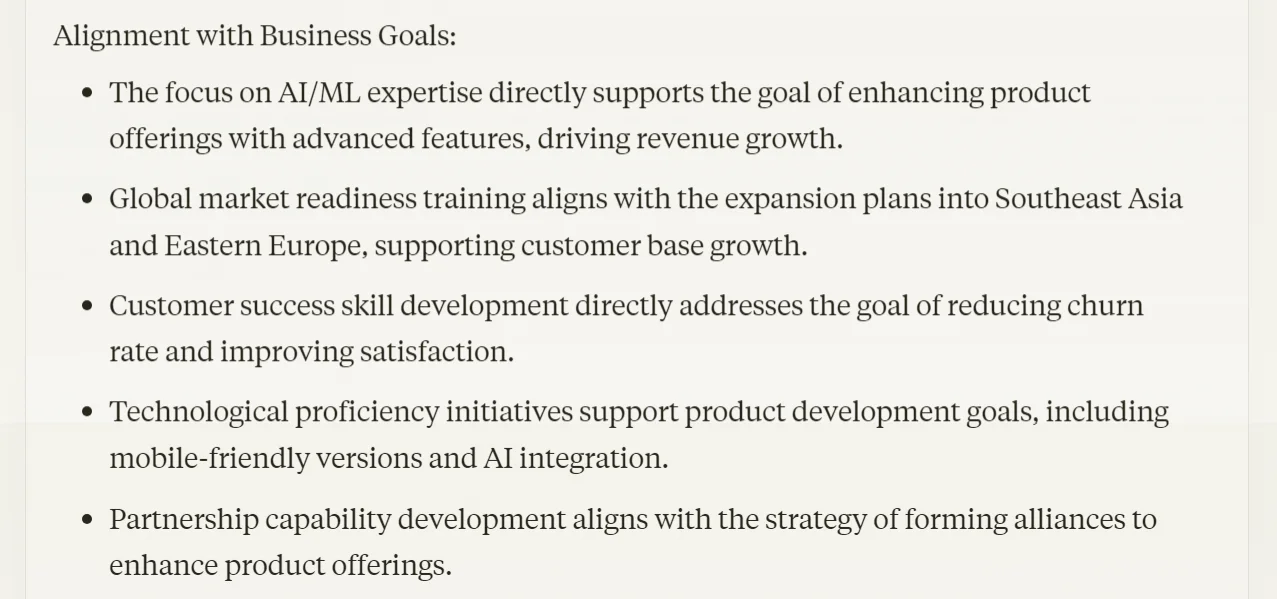
Claude will provide a draft L&D strategy that incorporates all the elements we've discussed. This draft is your starting point – a solid foundation that we'll refine and customize to fit your organization's unique needs and culture.
As your business strategy evolves and new challenges emerge, you'll need to revisit and refine your L&D strategy regularly. Use the process we've outlined here to ensure your L&D function remains a dynamic, responsive driver of organizational success.
This tutorial was created by Tanmay.