Develop customer journey maps with ChatGPT
Create detailed customer journey maps to optimize the customer experience using ChatGPT.
2024-11-13
Understanding your customers' interactions with your brand is essential for enhancing their experience and driving business growth. Customer journey mapping enables you to visualize these interactions from initial awareness to post-purchase support.
By leveraging the capabilities of ChatGPT, you can streamline the process of creating comprehensive customer journey maps. In doing so, you’ll uncover valuable insights that can drive meaningful improvements in your customer experience strategy.
In this tutorial, you will learn how to:
- Define customer personas to represent your target audience
- Identify and map key customer touchpoints across different stages
- Analyze customer emotions and pain points throughout the journey
- Uncover opportunities for improvement and develop action plans
Let's get to it.
Step 1: Define customer personas
Before mapping the customer journey, it's crucial to create representative profiles of your target audience. These personas will help you empathize with your customers and understand their unique goals, motivations, and pain points.
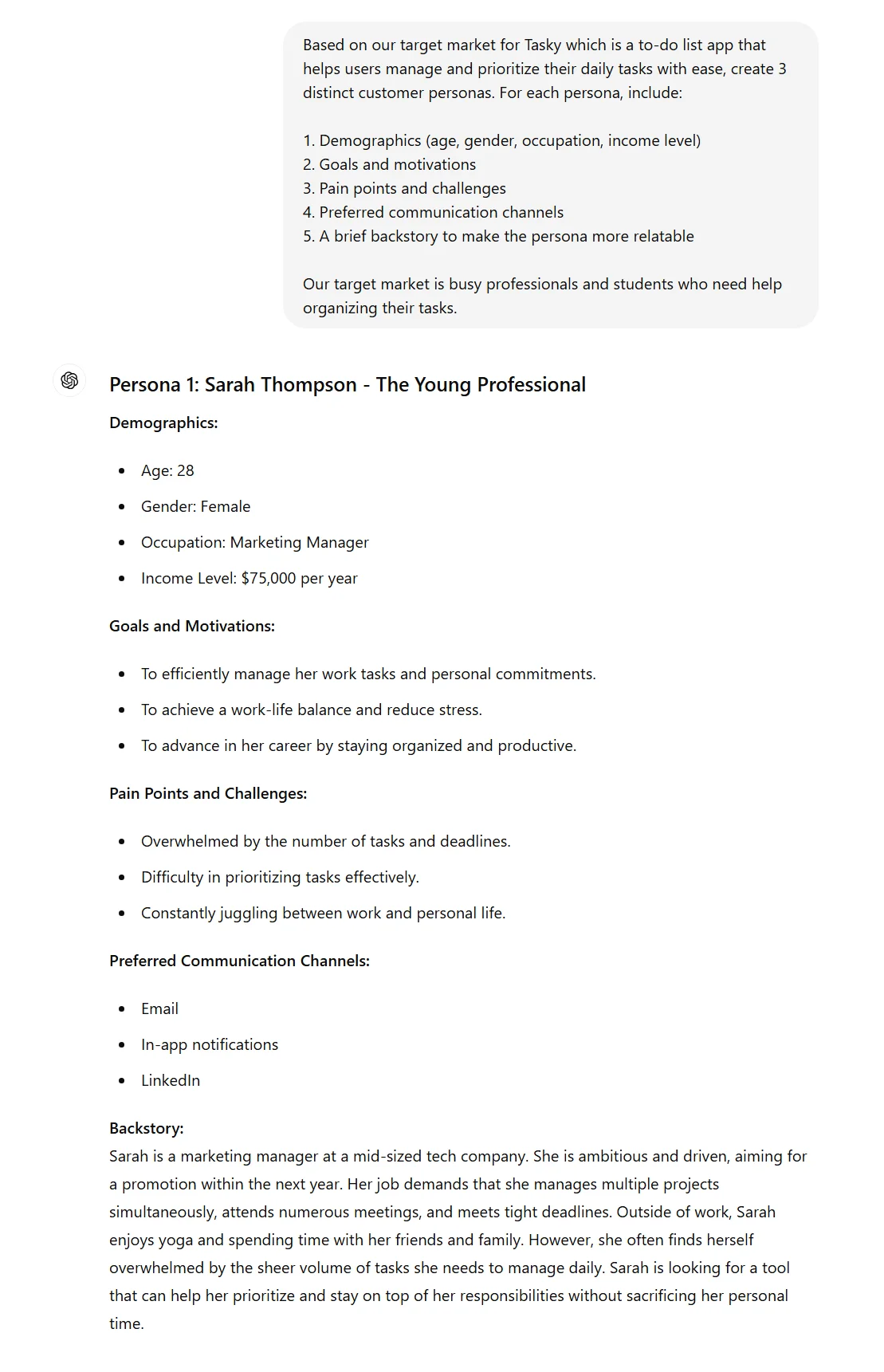
Prompt ChatGPT to help you create detailed customer personas:
Based on our target market for [your product/service], create 3 distinct customer personas. For each persona, include:
1. Demographics (age, gender, occupation, income level)
2. Goals and motivations
3. Pain points and challenges
4. Preferred communication channels
5. A brief backstory to make the persona more relatable
Our target market is [brief description of your target market].
.webp)
.webp)
ChatGPT will generate three distinct personas based on your input. Review the personas and make any necessary adjustments to ensure they accurately represent your target audience.
Step 2: Identify key customer touchpoints
Now that we have our personas, let's identify all the potential interactions these customers might have with your brand throughout their journey.
Prompt ChatGPT to help you brainstorm touchpoints:
Now, based on user personas, list all potential customer touchpoints across the following stages of the customer journey:
1. Awareness
2. Consideration
3. Purchase
4. Onboarding
5. Usage
6. Support
7. Loyalty/Advocacy
Consider both online and offline touchpoints, and include any unique touchpoints specific to our industry or business model.
.webp)
.webp)
Review the list and add any missing touchpoints specific to your business. This comprehensive overview will form the foundation of your customer journey map.
Step 3: Map the customer journey
With our personas and touchpoints identified, we can now create a visual representation of the customer journey. We'll use ChatGPT to help structure this information in a clear, actionable format.
Prompt ChatGPT to create a journey map template:
Now, create a customer journey map template based on the touchpoints we have identified. The template should include:
1. Journey stages (Awareness, Consideration, Purchase, etc.)
2. Customer actions
3. Touchpoints
4. Customer thoughts and emotions
5. Pain points or friction
6. Opportunities for improvement
Present this in a table format and provide the CSV download link.
.webp)
ChatGPT will generate a structured table that you can use as a template for your journey map.
Step 4: Identify pain points and improvement opportunities
Now that we have a comprehensive journey map, let's analyze it to identify potential pain points and areas for improvement across the customer journey.
Prompt ChatGPT to help identify pain points and improvement opportunities:
Based on our customer journey map for, let's identify potential pain points and areas for improvement at each stage of the customer journey. For each stage:
1. List possible challenges or friction points customers might face
2. Suggest potential improvement opportunities to address these challenges
3. Identify any gaps in our current touchpoints or processes
Consider the perspective of our different customer personas and how their needs might vary throughout the journey.
.webp)
.webp)
.webp)
Now, let's use this analysis to brainstorm specific solutions:
For the top 3 pain points we identified in our customer journey, suggest 3-5 specific solutions or improvements for each. Consider both quick wins and long-term strategies. For each solution, briefly explain how it addresses the pain point and benefits the customer.
.webp)
.webp)
Step 5: Develop action plans
Finally, let's create actionable plans to address the improvement opportunities we've identified. Prompt ChatGPT to help develop action plans:
For the top 3 improvement opportunities we identified in our customer journey map, create suitable action plans. For each opportunity, include:
1. Specific actions to be taken
2. Resources required (team members, budget, tools)
3. Timeline for implementation
4. Key performance indicators (KPIs) to measure success
5. Potential challenges and mitigation strategies
.webp)
.webp)
.webp)
ChatGPT will generate action plans for each opportunity. Review and refine these action plans, then prioritize them based on potential impact and feasibility.
Bonus
After developing action plans, use an Impact vs. Effort Matrix to prioritize your improvements effectively. This tool helps visualize and prioritize tasks based on their potential impact and the effort required to implement them.
Prompt ChatGPT to help create and populate your matrix:
Create an Impact vs. Effort Matrix for our [product/service] improvement ideas.
1. Set up a 2x2 grid with "Effort" on the X-axis and "Impact" on the Y-axis.
2. Label the quadrants: Quick Wins (High Impact, Low Effort), Major Projects (High Impact, High Effort), Fill-Ins (Low Impact, Low Effort), and Thankless Tasks (Low Impact, High Effort).
3. Plot the following improvement ideas on the matrix.
4. Based on this matrix, recommend which improvements to prioritize and why.
.webp)
.webp)
This tutorial was created by Tanmay.