How to learn more deeply with AI
Enhance your reading comprehension and retention with AI-powered learning techniques.
2024-12-12
Learning complex subjects doesn't have to feel like climbing a mountain alone. Imagine having a knowledgeable friend by your side as you tackle challenging texts, offering instant clarification and diverse perspectives. This tutorial introduces you to innovative ways of using ChatGPT that turn deep reading into an active, multi-dimensional learning adventure.
By integrating ChatGPT into your study routine, you'll discover how to engage with difficult topics more deeply, retain information more effectively, and develop a nuanced grasp of any subject matter.
In this tutorial, you'll learn how to:
- Use voice-assisted reading with ChatGPT
- Explore different perspectives on complex topics
- Simplify and understand complex text passages
- Create visual representations of abstract concepts
The steps in this lesson are inspired by Dan Shipper, who shared with us in his live workshop how he uses ChatGPT for deep learning and creative writing.
Let’s dive in.
1. Voice-assisted reading with ChatGPT
Imagine you're curled up with a book on quantum physics. Instead of scribbling notes or constantly reaching for your phone to Google unfamiliar terms, you have a knowledgeable friend right there, ready to explain everything. That's the magic of ChatGPT's voice mode – it turns your smartphone into a pocket-sized genius.
ChatGPT's voice mode comes in two flavors: standard and advanced. While the advanced mode is still in limited release at the time of writing, the standard mode is widely available and perfectly suited for our learning needs. It uses text-to-speech technology to vocalize ChatGPT's responses, creating a seamless conversation-like experience.
To use voice mode, simply open the ChatGPT app on your smartphone and tap the headphone icon in the bottom. Now, as you read, you can ask questions out loud, and ChatGPT will respond verbally, offering explanations, examples, or additional context.

Now, let's say you're knee-deep in a chapter about quantum superposition, and your brain is doing mental gymnastics trying to grasp the concept. Instead of getting lost in a Wikipedia rabbit hole, you can simply ask ChatGPT:
Hey ChatGPT, can you break down quantum superposition for me? Imagine you're explaining it to someone who thinks Schrödinger's cat is just a particularly indecisive feline.
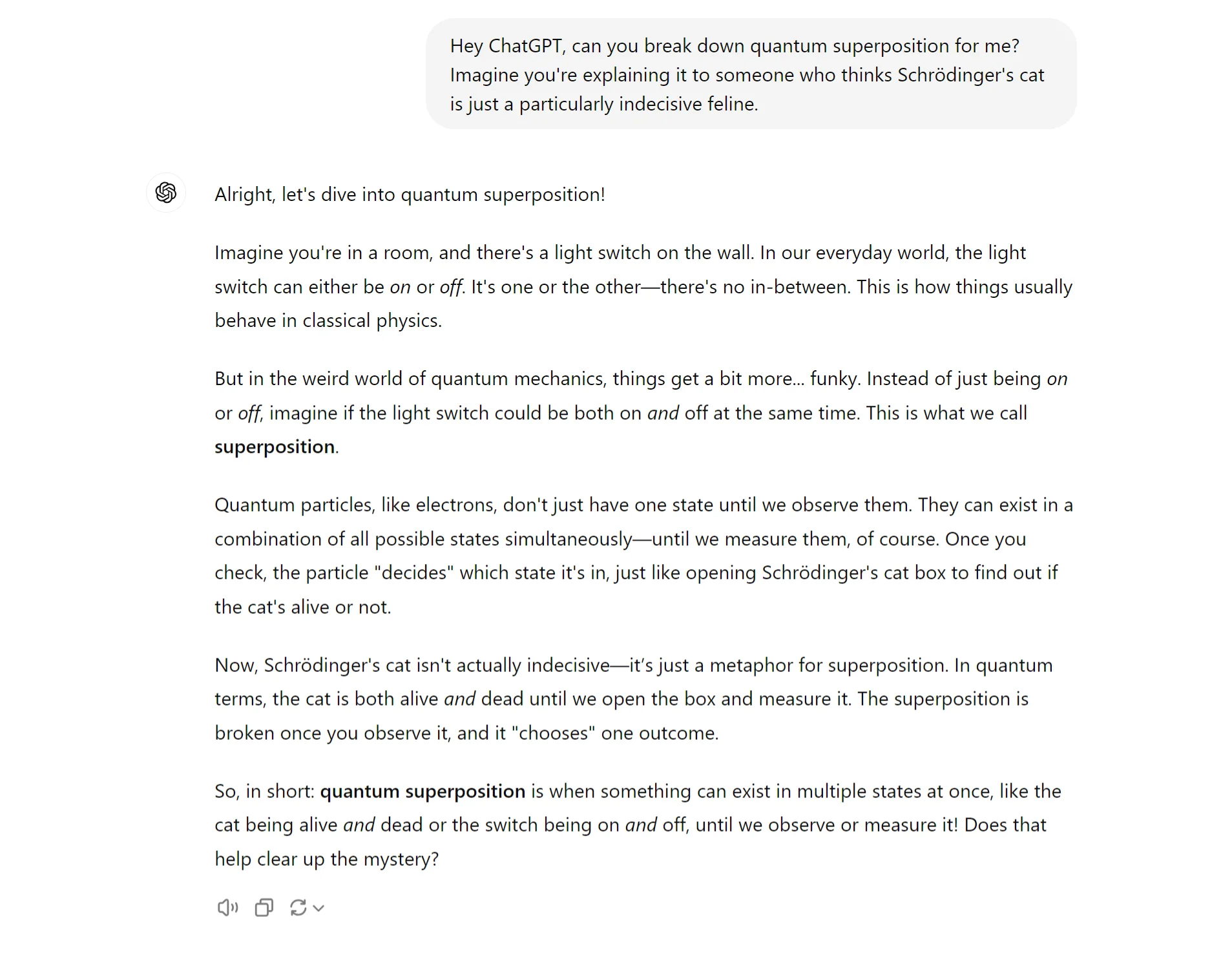
Or perhaps you're trying to connect the dots between different concepts:
How does quantum superposition relate to quantum computing? Can you explain it using a pizza analogy?
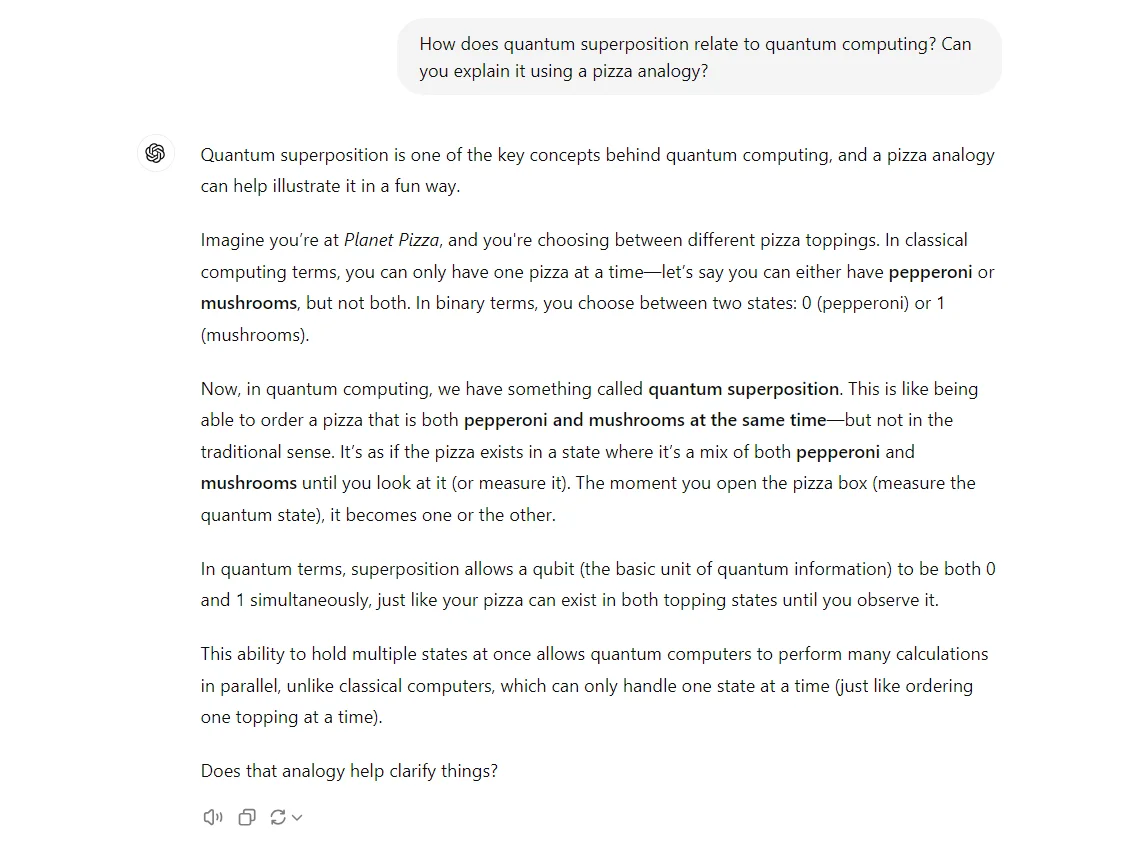
This real-time clarification is like having a study group in your pocket, helping you grasp complex ideas without losing your reading momentum. The beauty of this approach is that you can tailor your questions to your learning style. Visual learner? Ask for analogies. Prefer step-by-step explanations? Request a breakdown of the process.
ChatGPT, can you give me a step-by-step explanation of how quantum superposition is used in quantum cryptography? Break it down as if you're teaching a coding newbie.
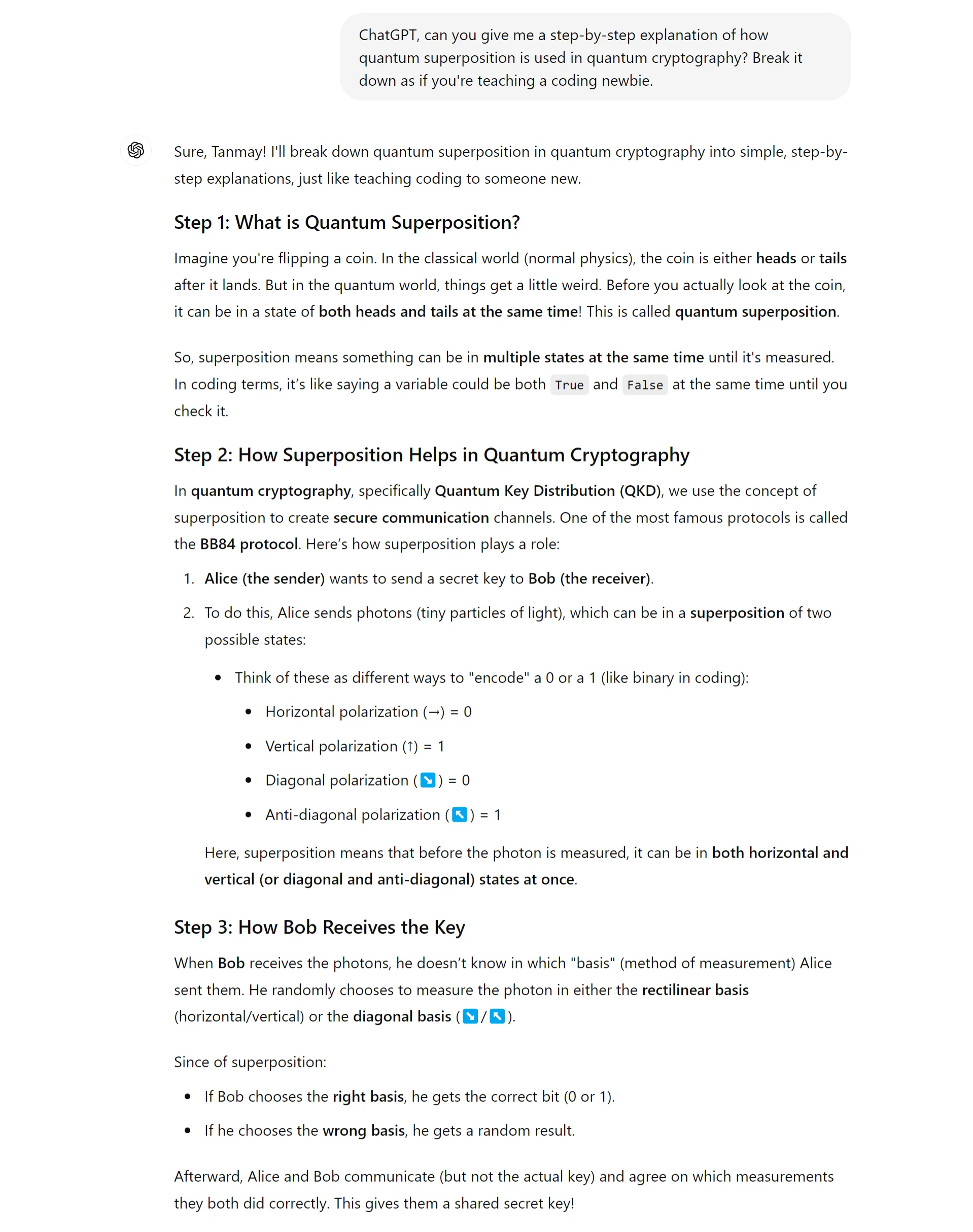
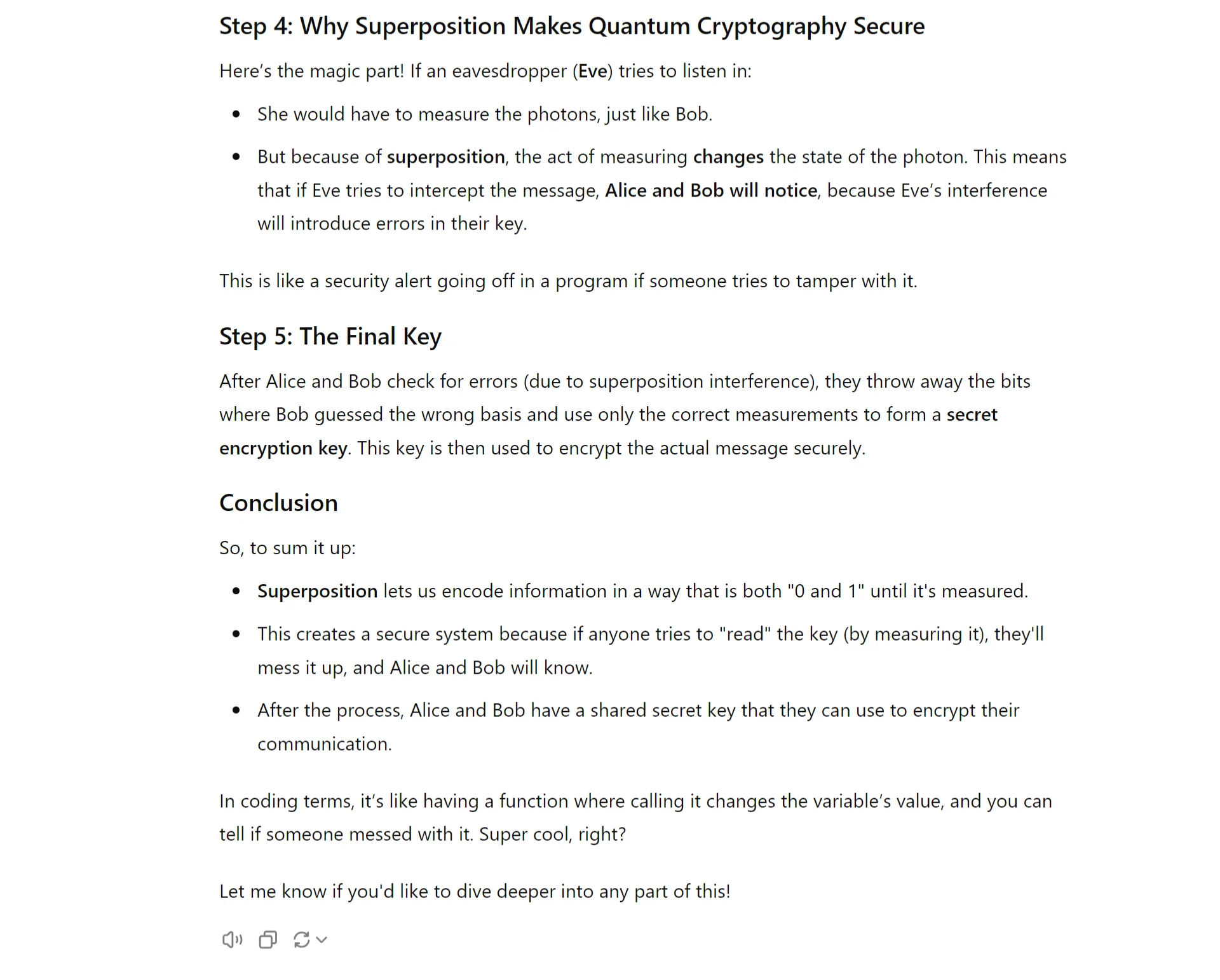
By engaging in this intellectual tango with ChatGPT, you're not just passively absorbing information – you're actively processing and connecting ideas. It's like mental CrossFit for your brain, and the gains in understanding are impressive.
2. Exploring different perspectives
One of the hallmarks of true understanding is the ability to see a topic from multiple angles. AI can be an invaluable tool in this regard, helping you explore various viewpoints and challenge your own assumptions.
Let's say you're diving into the heated debate about social media's impact on mental health. After reading a few articles that seem to contradict each other, you might feel like you're watching a tennis match of opposing viewpoints. This is where ChatGPT comes in clutch.
Try this prompt:
I'm studying the impact of social media on mental health. Can you give me a balanced overview of the main arguments for and against, including any surprising or counterintuitive findings? Also, are there any perspectives from fields outside of psychology, like anthropology or economics, that shed new light on this issue?

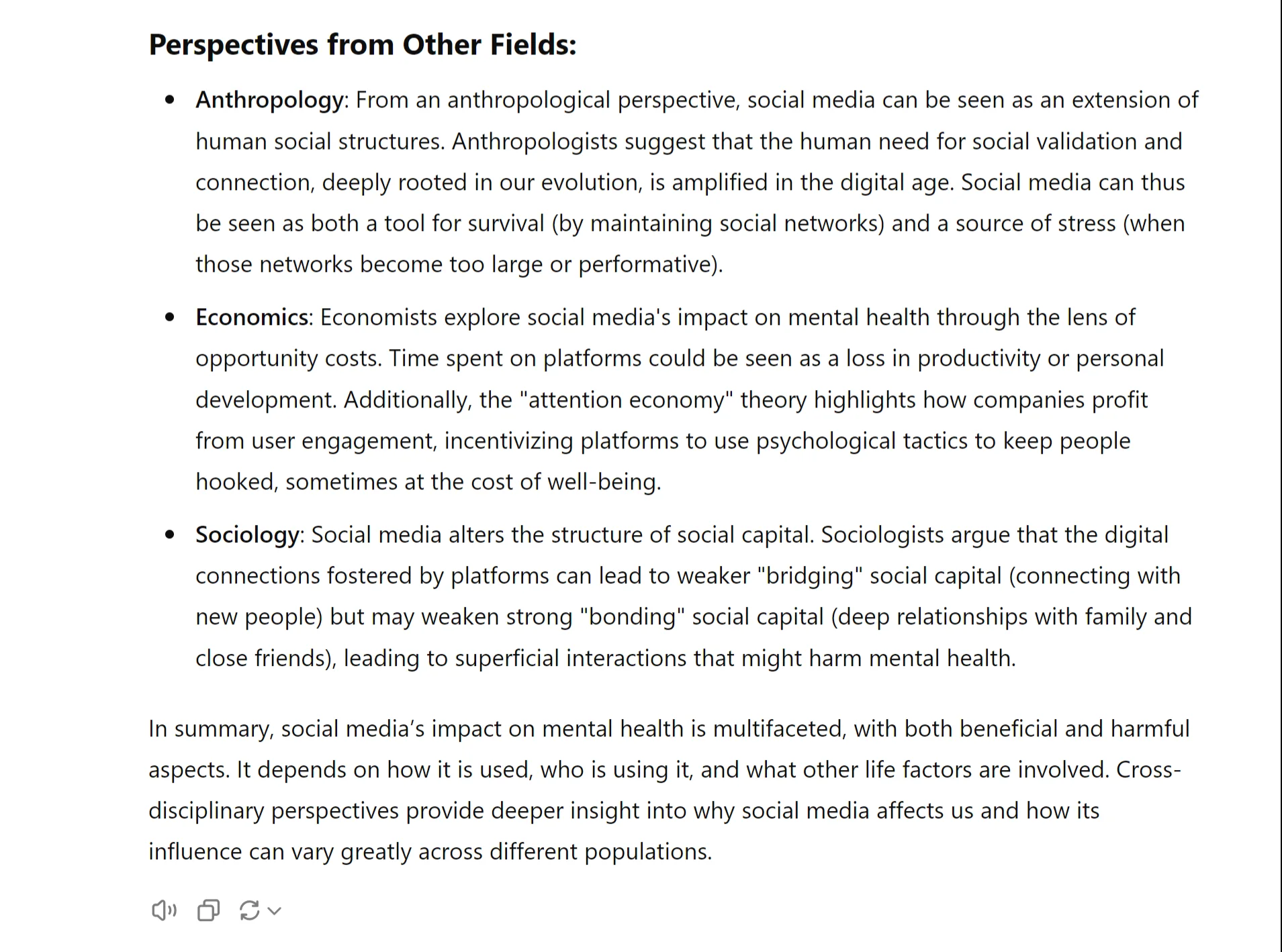
It not only gives you the main points of contention but also introduces you to perspectives you might not have considered. It's like turning on the lights in a dark room – suddenly, you can see all the furniture, not just the outlines you were bumping into before.
But why stop there? You can dive even deeper:
Based on the overview you provided, what are some potential future research directions that could help resolve some of the conflicting findings on social media and mental health?

These follow-up questions help you think like a researcher, identifying gaps in current knowledge and considering how different contexts might affect the findings. It provides a springboard for further exploration and critical thinking.
3. Simplifying complex text passages
Sometimes, academic or technical writing can be so dense that it feels like you're reading a foreign language. This is where ChatGPT can act as your personal translator, recasting complex ideas into more digestible forms.
Imagine you're reading a paper on cognitive neuroscience and come across this passage:
The hippocampus, through its dense reciprocal connections with neocortical regions, is thought to support the reinstatement of distributed memory traces, facilitating the integration of new information into existing knowledge structures via synaptic plasticity mechanisms.
Rather than getting bogged down, you can ask ChatGPT to simplify it:
I'm trying to understand this passage about the hippocampus. Can you rewrite it for someone who's interested in neuroscience but doesn't have a Ph.D.? Maybe use an analogy involving a library or a computer network?
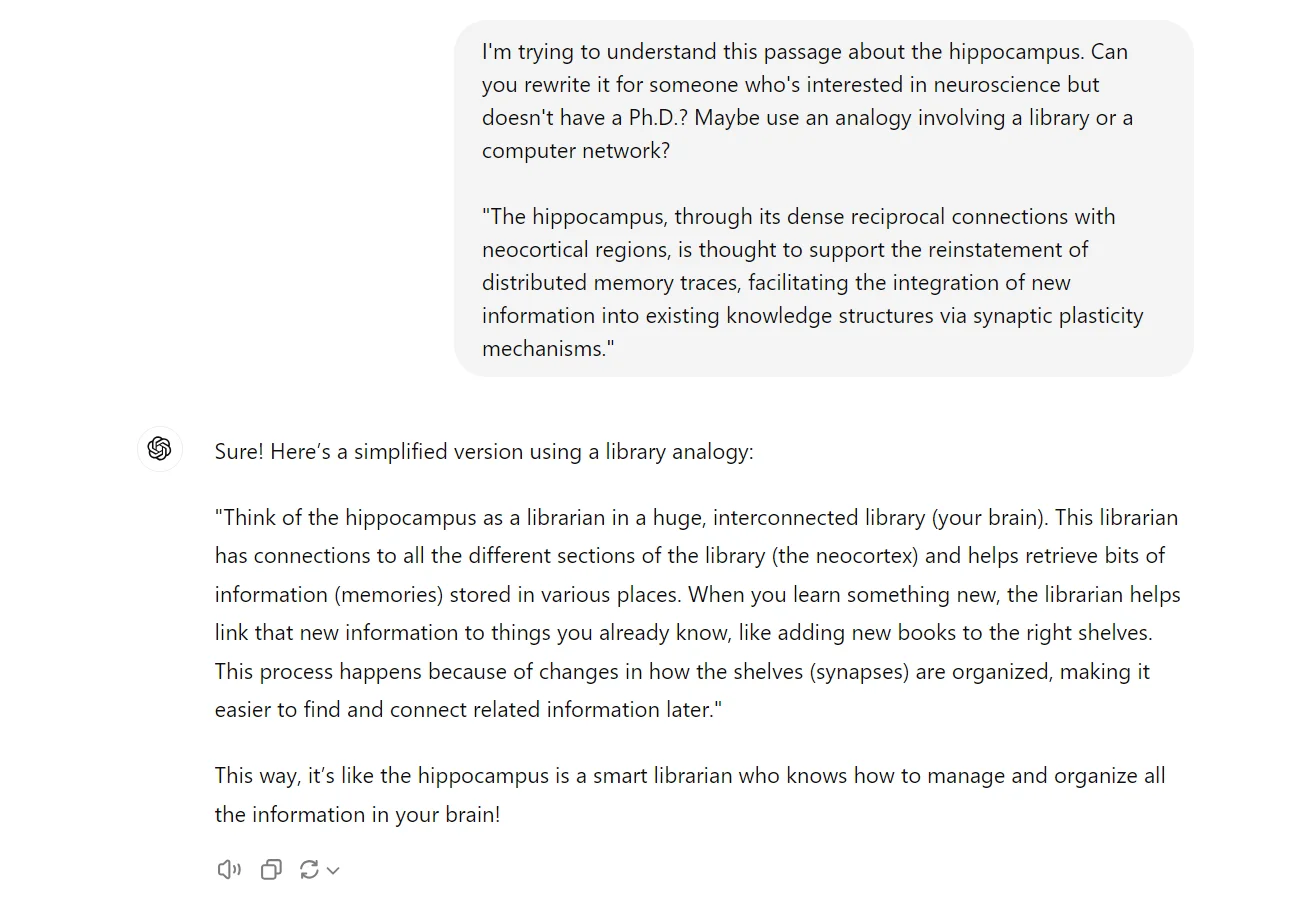
You're not asking ChatGPT to dumb it down – you're asking it to translate the concept into a language that resonates with your current level of understanding. It's like having a skilled teacher who knows just how to bridge the gap between what you know and what you're trying to learn.
But let's take it a step further. Once you have a basic understanding, you can start to rebuild the complexity:
Now that I understand the basics, can you explain how this function of the hippocampus might be disrupted in conditions like Alzheimer's disease?
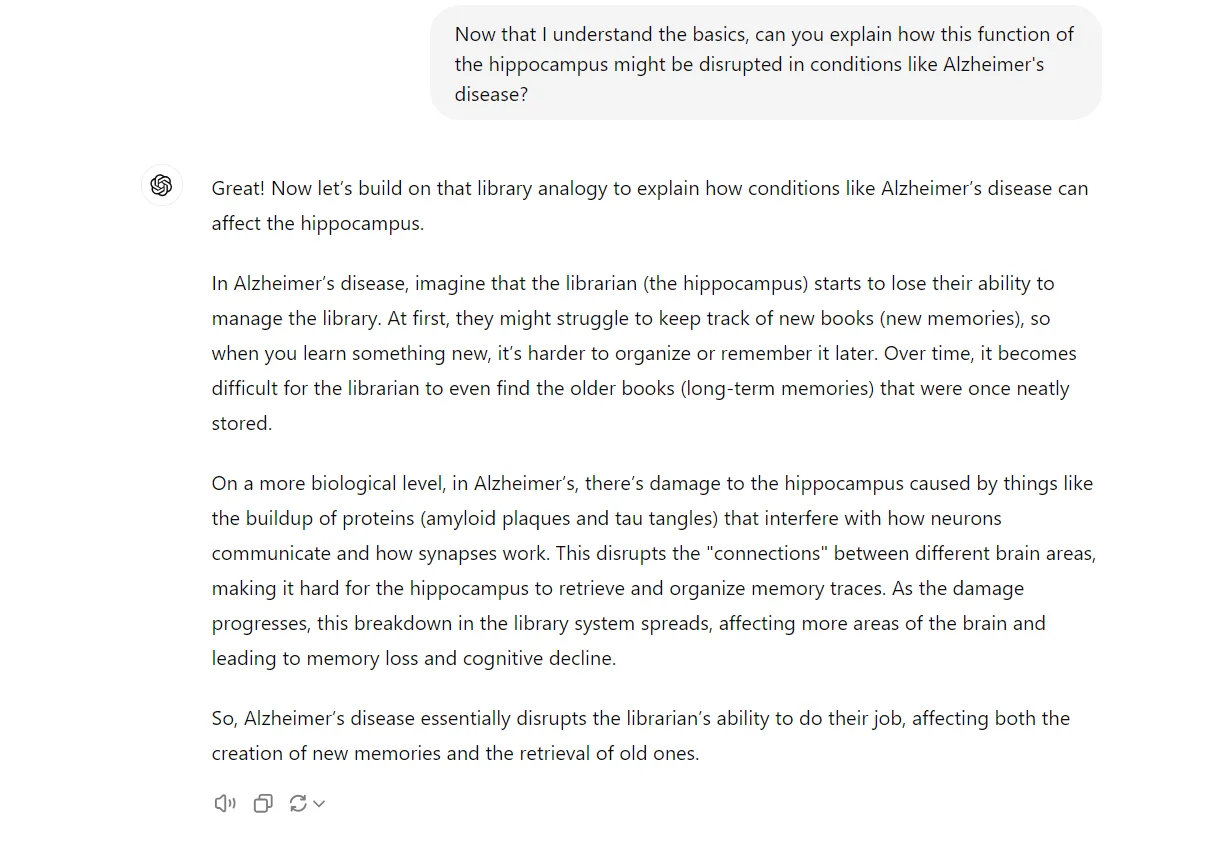
Or:
How does this role of the hippocampus in memory relate to its involvement in spatial navigation?
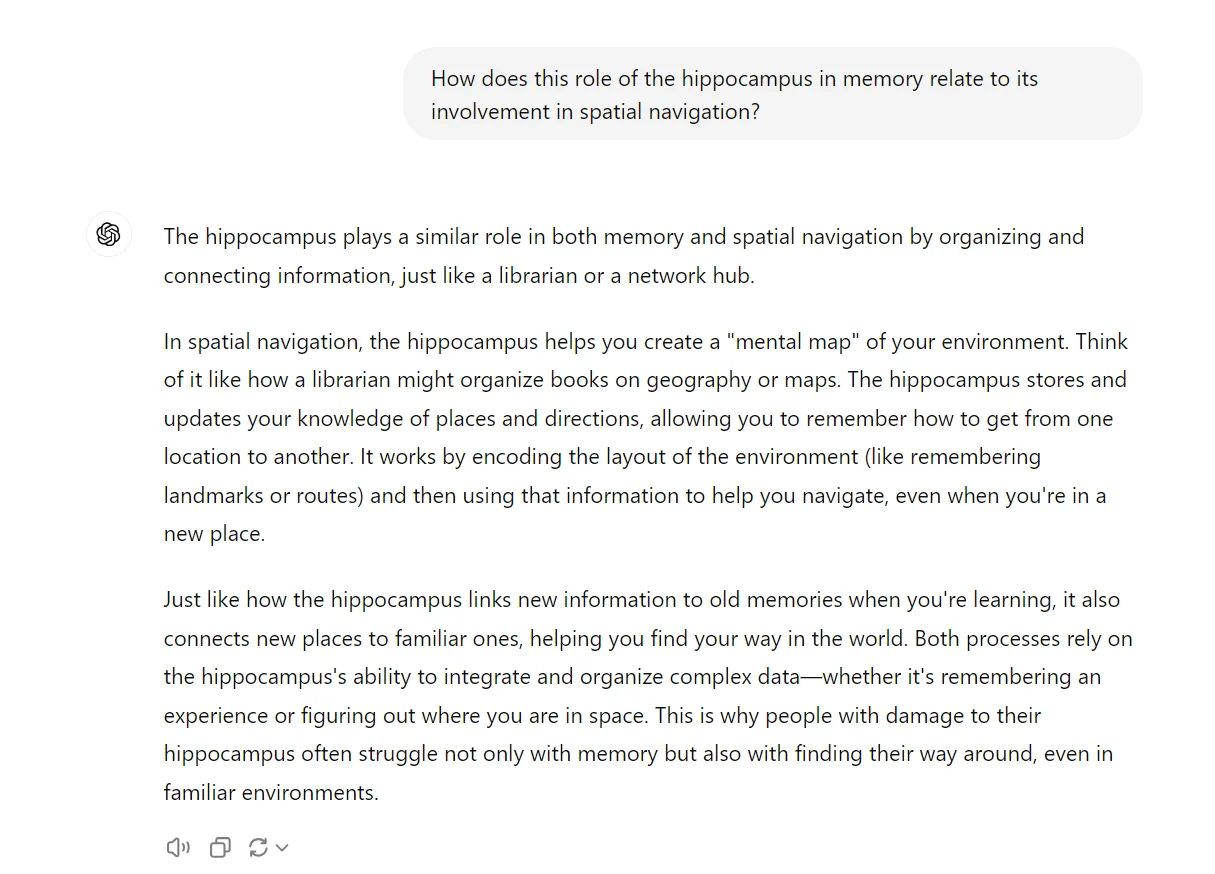
This simplified explanation, complete with an analogy, makes the concept much more approachable. It gives you a mental framework to hang the more technical details on as you continue your reading.
4. Creating visual representations
Sometimes, words alone aren't enough to fully grasp a concept. Visual representations can bridge the gap between abstract concepts and concrete understanding, turning flat text into a vivid, memorable experience.
Consider the power of visualization when studying literature, particularly poetry. Poetry, with its rich imagery and metaphors, can sometimes feel elusive. But what if you could see the poet's words come to life? Let's take Robert Frost's famous poem, "The Road Not Taken," as an example.
Imagine you're reading the first stanza:
Two roads diverged in a yellow wood,
And sorry I could not travel both
And be one traveler, long I stood
And looked down one as far as I could
To where it bent in the undergrowth;
Here's a prompt you might use in ChatGPT to help you understand the meaning behind the text:
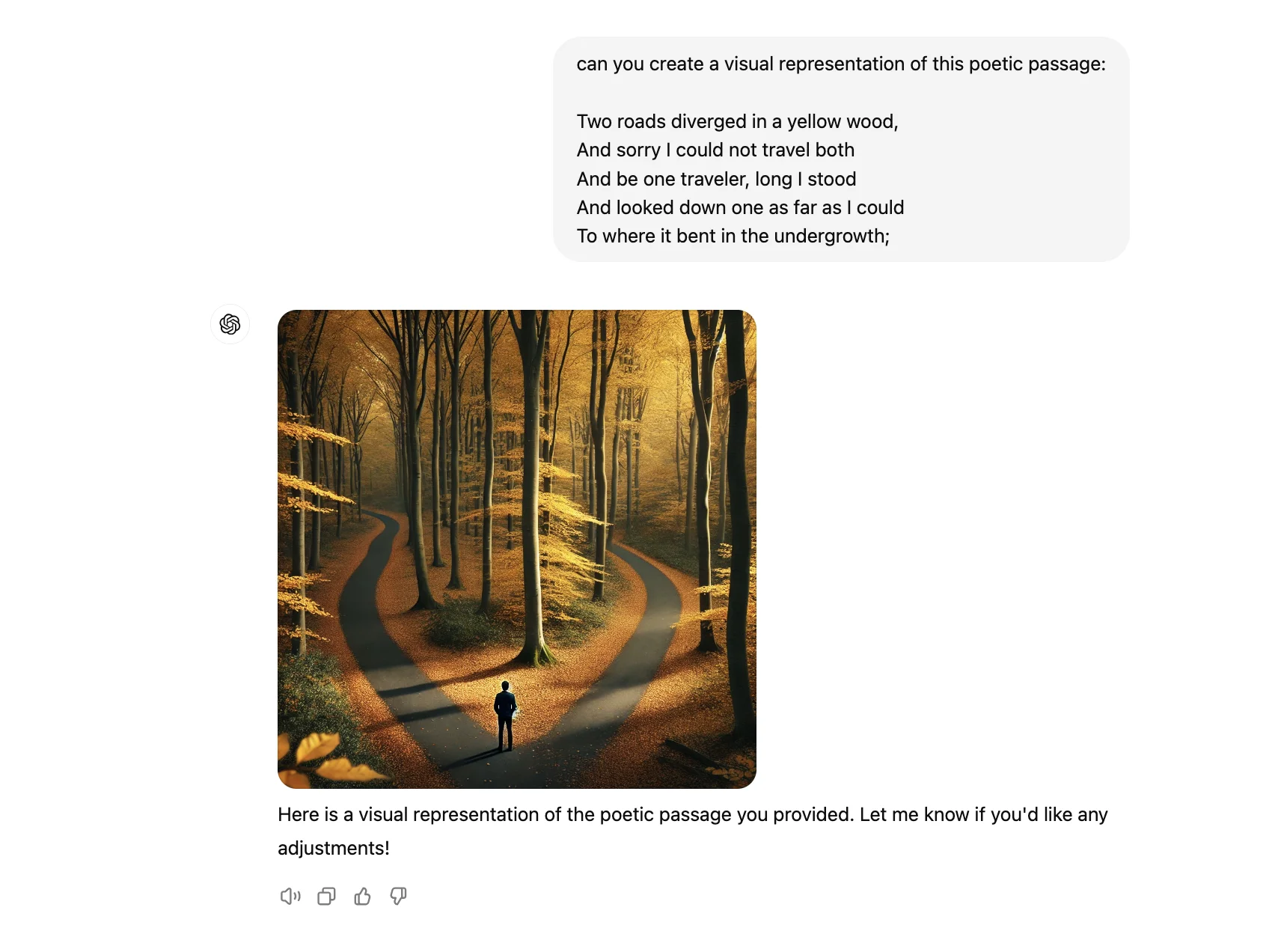
The resulting image isn't just an illustration – it's a powerful learning aid. It might show a sun-dappled forest path splitting in two, with golden leaves carpeting the ground. The viewer's perspective could be from the point of decision, emphasizing the poem's theme of choice.
But the learning doesn't stop at image generation. Use this visual as a springboard for deeper analysis:
How does this visual representation of the poem's first stanza enhance our understanding of Frost's themes? What elements in the image particularly emphasize the concept of life-altering decisions?
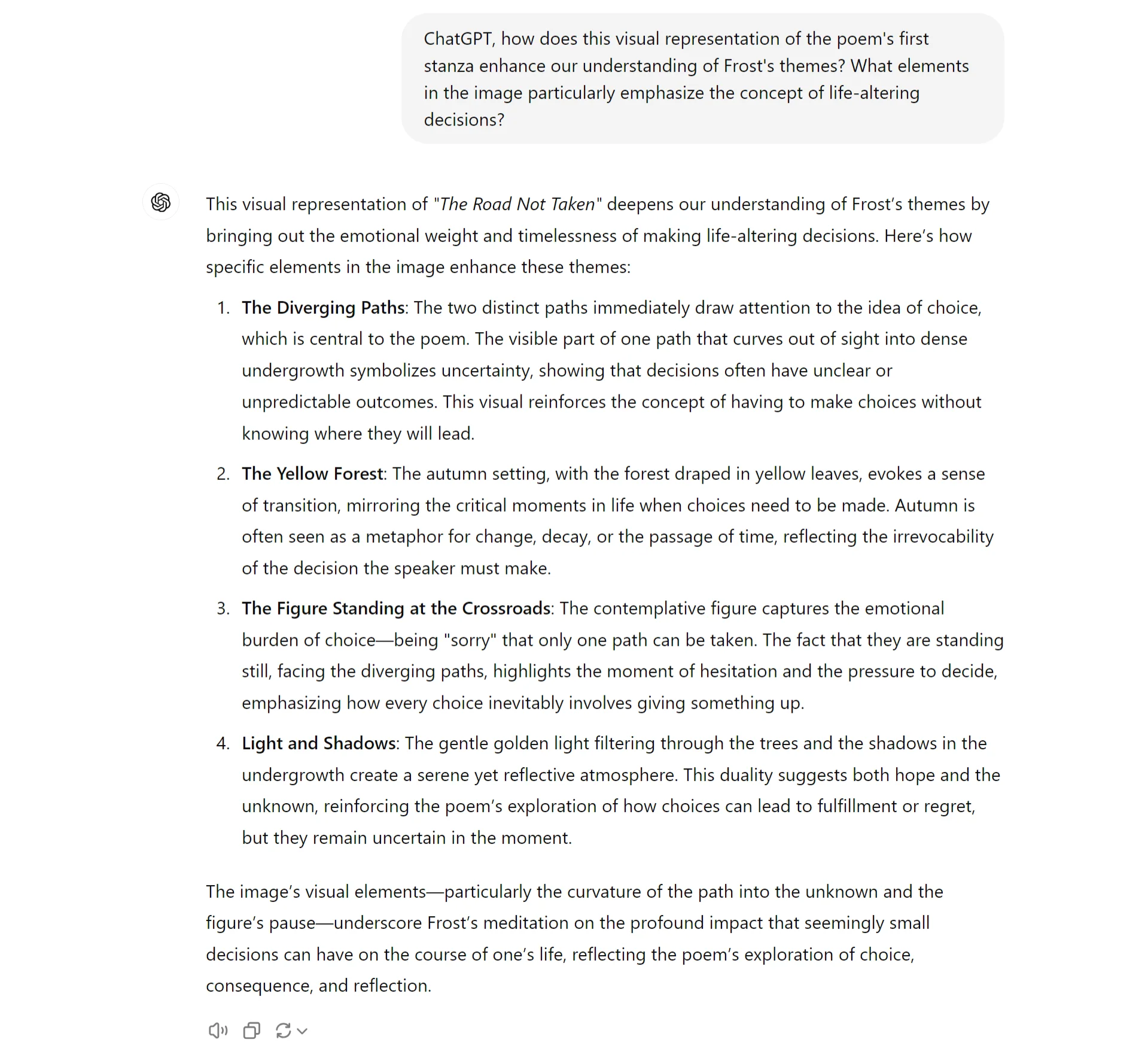
This prompt encourages you to analyze how visual elements correspond to and enhance the poem's meaning.
For students, professionals, or anyone engaged in lifelong learning, this visual-textual integration technique can be a game-changer. It turns abstract ideas into concrete visuals, making complex concepts more accessible and memorable. It's like giving your brain a high-definition upgrade, allowing you to process and retain information with greater clarity and depth.
This tutorial was created by Tanmay.