Optimize marketing channel mix
Analyze multi-channel marketing performance and optimize budget allocation.
2024-11-13
Effective marketing isn't just about reaching customers—it's about reaching them through the right channels, at the right time, with the right budget. Maximizing your marketing budget's impact is crucial for business growth, but determining the optimal allocation across channels can be challenging.
In this tutorial, you will use AI to:
- Prepare and visualize your marketing performance data
- Compare ROI and CAC for each channel
- Develop scenarios for budget allocations
- Produce an optimal marketing mix
Let's dive in.
Step 1: Prepare your marketing performance data
Before we begin our analysis, we need to gather data on your marketing efforts across all channels. Quality and completeness of your data will directly impact the accuracy of our analysis and recommendations, so make sure that the data is accurate.
You can compile your marketing data from various platforms into a single CSV file. If you're already tracking these statistics, great! If not, you'll need to collect the following information for each marketing channel:
- Marketing channel name (e.g., Social Media, PPC, Email, Content Marketing)
- Time period (e.g., monthly data for the past year)
- Marketing spend per channel
- Impressions per channel
- Clicks per channel
- Conversions per channel
- Revenue per channel
If you prefer not to compile the data yourself, you can upload individual reports from your marketing platforms directly to the AI tool. For this tutorial, we'll use a dummy CSV report for HappyWorld Inc., a fictional D2C platform selling kids toys. The CSV includes all the required information.
Now, let's use Claude to process and analyze this data. We'll start by asking it to read and summarize the CSV file:
I have a CSV file containing marketing performance data for [Your Company Name], a [brief description of your business]. The file includes data on various marketing channels, including spend, impressions, clicks, conversions, and revenue. Analyze this data and provide a summary of the key metrics for each channel over the period. Include total spending, total revenue, overall ROI, and any notable trends or patterns you observe.

Review the summary to ensure it has correctly interpreted your data. This overview will serve as the foundation for our deeper analysis in the following steps.
Step 2: Visualize marketing performance data
Now that we have a summary of our marketing data, let's create some visualizations to help us better understand the performance of each channel. Visual representations can reveal patterns and trends that might not be immediately apparent from raw numbers.
We'll ask Claude to generate several types of charts to give us a comprehensive view of our marketing performance:
Based on the marketing performance data, please create the following visualizations:
1. A stacked bar chart showing monthly spending across all marketing channels
2. A line graph comparing monthly revenue for each channel
3. A pie chart showing the distribution of total spending across channels
For each visualization, provide a brief interpretation of what the data reveals about our marketing performance.
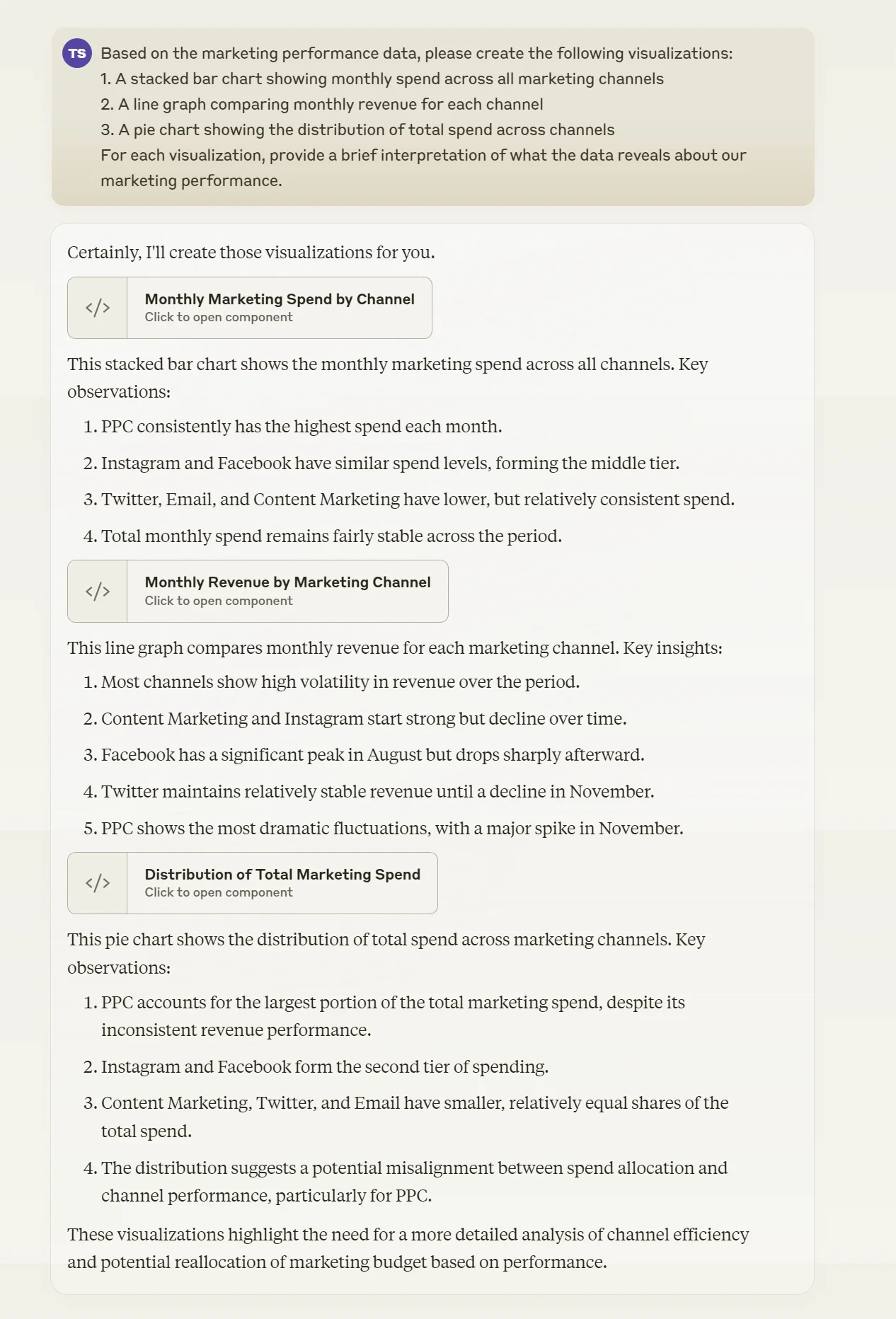
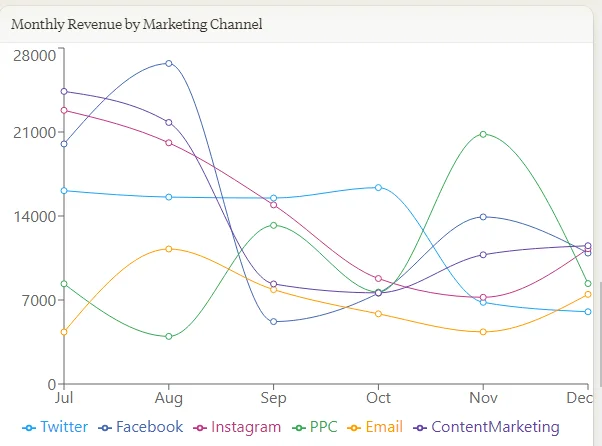
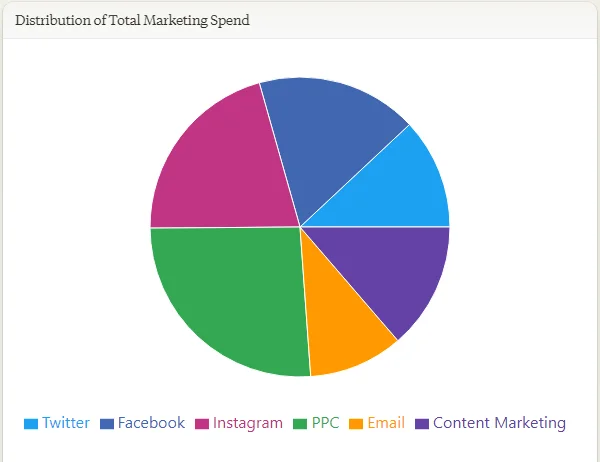
Look for any surprising insights or patterns that stand out. These visual representations will help guide our analysis in the following steps and make it easier to communicate our findings to stakeholders.
Step 3: Compare ROI and CAC for each channel
With our data visualized, we can now dive deeper into the performance metrics for each channel. Two crucial metrics we'll focus on are Return on Investment (ROI) and Customer Acquisition Cost (CAC). These metrics will help us understand which channels are most effective at driving revenue and acquiring customers efficiently.
Let's ask Claude to calculate and compare these metrics across our marketing channels:
Using the marketing data, please calculate and compare the following metrics for each channel:
1. Return on Investment (ROI) = (Revenue - Spend) / Spend
2. Customer Acquisition Cost (CAC) = Spend / Number of Conversions
Present the results in a table, sorted by ROI in descending order. Also, provide a brief analysis of the top-performing and underperforming channels based on these metrics. Highlight any channels that have high ROI but low total revenue, or vice versa, as these may represent opportunities for scaling or optimization.
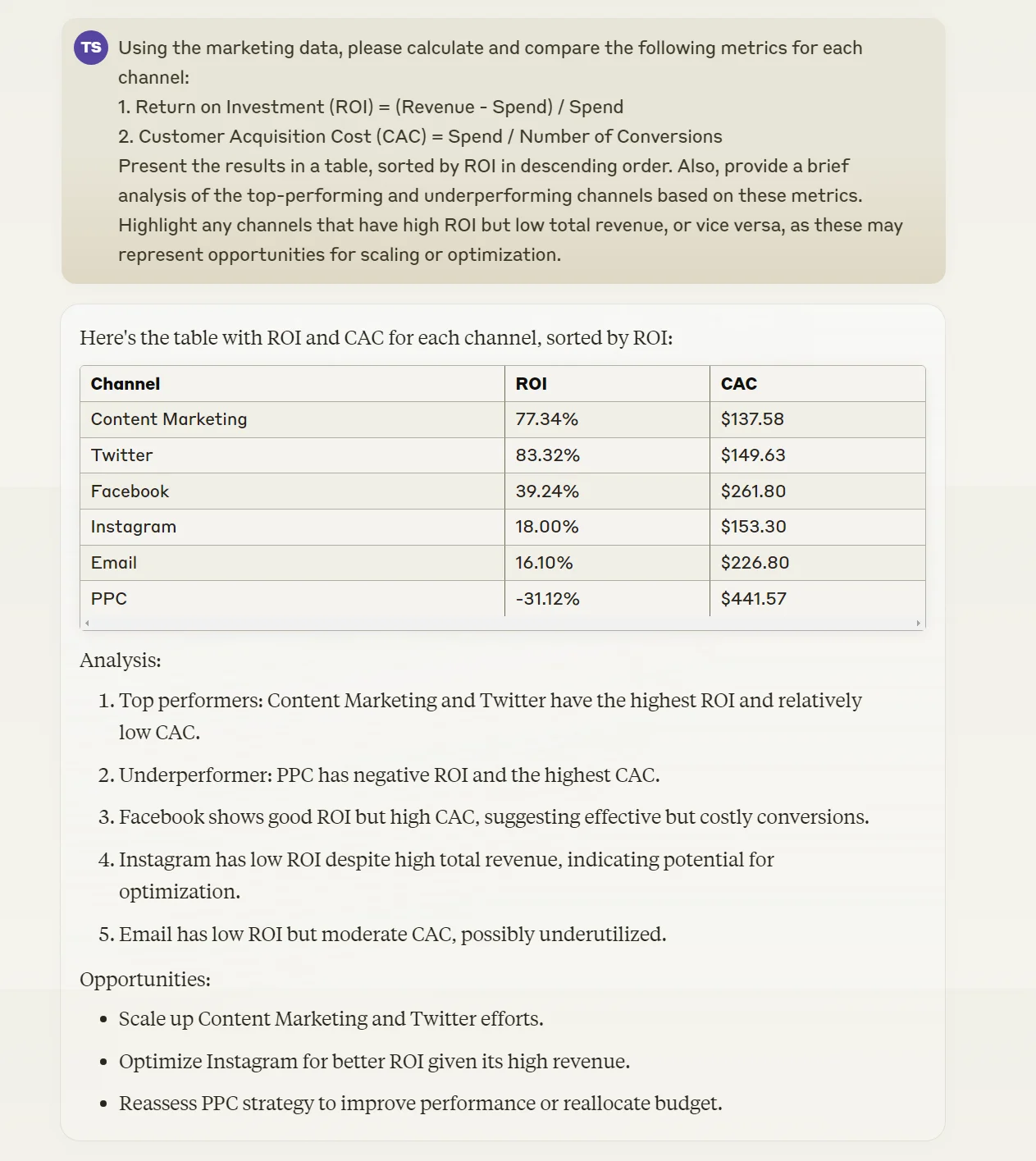
Pay special attention to channels that show high ROI but low total revenue, as these might be opportunities for scaling. Conversely, channels with low ROI but high spending might be candidates for budget reallocation or optimization.
Step 4: Develop scenarios for budget allocations
Now that we have a comprehensive understanding of our channel performance, we can start exploring different scenarios for budget allocation. We'll generate and analyze various budget distribution scenarios based on our findings so far.
Prompt Claude to create these scenarios:
Using the insights gained from our analysis of marketing data, please develop three different budget allocation scenarios:
1. Optimization based on ROI: Allocate more budget to high-ROI channels while reducing spend on low-ROI channels.
2. Scaling high-potential channels: Identify channels with high ROI but low total revenue, and increase their budget to test scalability.
3. Balanced approach: Distribute the budget more evenly across channels, with slight adjustments based on performance.
For each scenario, provide:
1. The proposed budget allocation across channels (in percentages)
2. Projected results (estimated impressions, clicks, conversions, and revenue) based on historical performance
Finally, compare these scenarios to our current budget allocation and discuss the trade-offs involved in each approach.
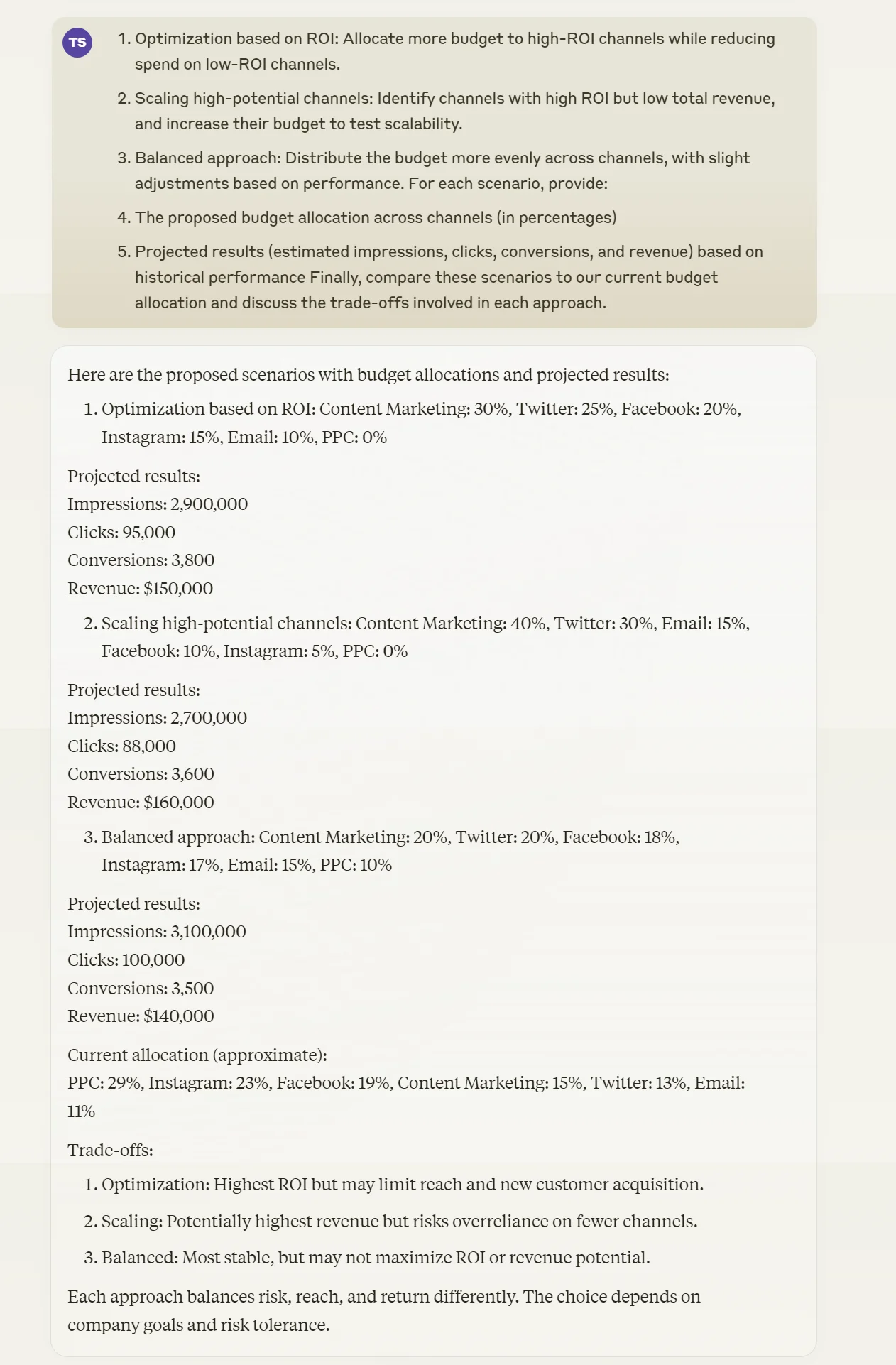
Consider the projected results, risks, and benefits of each approach. Think about how these scenarios align with your overall business goals and risk tolerance.
Step 5: Produce an optimal marketing mix
Based on all the analysis we've done, we're now ready to produce a final recommendation for an optimal marketing channel mix. This recommendation should take into account all the insights we've gained, including ROI, CAC, attribution models, and the different budget allocation scenarios.
Let's use Claude to synthesize all this information and provide a final recommendation:
Taking into account all the analysis we've done, including ROI, CAC, attribution models, and budget allocation scenarios, please provide a final recommendation for an optimal marketing channel mix. Your recommendation should include:
1. A proposed budget allocation across all marketing channels (in percentages)
2. Justification for each channel's allocation, referencing our previous analyses
3. Expected outcomes in terms of impressions, clicks, conversions, and revenue
4. A proposed timeline for implementing and evaluating this new marketing mix
Additionally, provide guidance on how often this analysis should be repeated to ensure our marketing mix remains optimized over time.
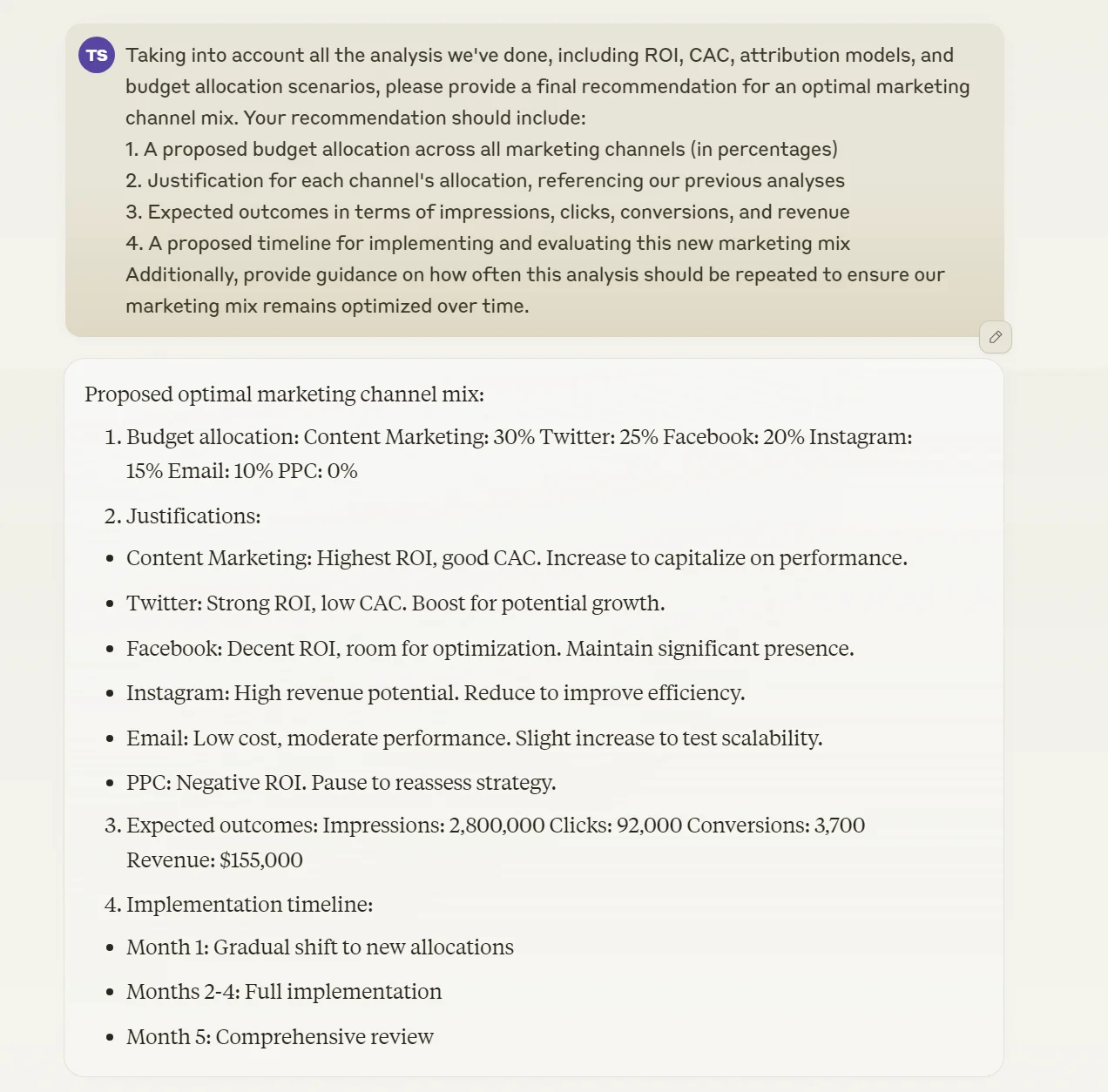
With this prompt workflow, you've gained deep insights into your marketing performance and developed data-driven recommendations for optimizing your budget allocation.
Implement the recommended changes gradually, closely monitor your KPIs, and be prepared to adjust your strategy as you gather more data. Regularly repeating this analysis will help ensure that your marketing mix remains optimized in the face of changing market conditions and consumer behaviors.
This tutorial was created by Tanmay.